Thursday, November 22

Florence 4: “LOOK! Look there. See?”

><- Click here
Photography has a unique power in its ability to point. Some even say that it’s what photographers in snapshots, advertising, photojournalism, wedding, fashion – even fine art photography – in its every use they say it is what we do best. The lens has the ability to focus attention upon a child’s giggle, the tear of a bride’s mother, blood on the sidewalk, or a vivid personal idea about how sunrise coats a great river like The Arno as it wends through Florence.

“See that?” The picture asks? And we not only see it, but through the mind and feelings of the guy or gal who pulled the trigger.

And when we realize that it’s part of the role of photographers to point, we begin to understand that it is also our right.

---

I'm in an odd mood this Thanksgiving Day. I'm lost for the right word. Sometime yesterday afternoon my stomach went crampy from the visit of a virus. So after a sleepless night, I'm taking calmatives and listening to Barbara Carroll albums. Under those dual influences plus this holiday reverie - Lancaster seems both connected to everything, and adrift on its own. Is there a word for that? The morning on the Arno a few weeks ago seems like this morning. I can hear a bicycle's bell and quiet scooters. Oddly, the Arno, just below my camera, flowed silent between the walls that hold back its capricious floods.

YAWN! It's a good evening to meditate on things that make both Rita and I thankful. Happy Thanksgiving world.

Wednesday, November 21

Florence 3: Metal Heads

<- Click here
Crowds begin to form at around sunrise. They queue up outside of the medieval palace and office building for the Medici – which is now the Uffizi Gallery home of one of the world’s greatest art collections. Scalpers sell reserved tickets to people who will frequently wait five hours in line.

I don’t know how many of these metal headed guys were scattered around Florence last month. There were two nearby to the crowds waiting here outside of the Uffizi, and later in the afternoon I found two more some distance away.

You know photographers have a lot in common with sculptors. Unlike, say painters or poets who start with nothing and then build up an idea – sculptors and photographers start with large hunks and then whittle stuff away. Alfred Stieglitz almost a century ago wrote about how photographers, “… depict life in scraps and fragments.” And we do it frequently, he went on, by preserving a sense of setting for our subjects while using the picture’s edge to slice off whatever distracts from our mood.

GEEK STUFF: Canon EOS 20D, 10/7/07, 9:21 AM: Lens 17-85mm, Focal Length: 26mm, Exp 1/15@f/4.5, ISO 100, Metering Mode: Average, Exposure bias -1, Camera RAW

Tuesday, November 20

Florence 2: Mike's Coming, Right?

><- Click here
To a short term visitor, Florence is as much a swirl of moods as it is hard stuff, like stones, glass, hills, and paint. There are phantoms here of great emotions that you can sense even at a typical street corner aglow in the morning’s first light.

It seems to me that a painter forms a feeling while a photographer reveals one. It’s not just the difference in our impliments but we have an enormously diverse set of materials to work with. Here, I had the feeling that Michelangelo could just strut around that corner to the left on his way to release David from a large piece of marble.

Monday, November 19

2007 Award Winner: Florence & The Manessinger Challenge

Note: The window scene below has been accepted as one of the world's finest Still Life images of 2007 for Canon POTN Book to be published in the Fall of 2008.

<-Click here
Add Florence to its suburbs and you’ll tote up about 600,000 mostly Italian people the others being Albanian, Romanian, German, Chinese, and North African. They live at the epicenter of Renaissance art history. You can’t toss a rock in this city for fear of smashing some important sculpture or defacing a significant 15th or 16th century building. Florence emanates what the Western World calls elegance. As a partner with Milan, the city is home to legendary fashion creators. And its shops are branded with names like Ferragamo, Prada, Cavalli, and Chanel. Just to the north and north-west the textile industries continue to roll out some of the world’s finest fabrics.
Florence, or Firenze as it is called by Italians, is such a huge warehouse of art works by the historic masters that a firestorm or another catastrophic flood of the River Arno (which bisects the city) could wreak havoc upon the world’s greatest Renaissance treasures.

Artistically, Florence is overwhelming. For art it is our attic, our basement, and our garage. With only a week to spend, it quickly became apparent that we could do little more than take in the facades, visit some shops and look at the very highlights. But even then, I came away feeling as if I had merely seen, rather than come to know of any this astonishingly large - little place.

---

Mano-A-Mano

On Saturday, October 6th, world renowned fine art photographer Andreas Manessinger
drove down from his perch in Vienna to dine with me, and to accept my challenge to a single morning of photography the following sunrise starting at the façade and campanile of Santa Maria del Fiore, the city’s most imposing structure, popularly called The Duomo!

Sometime between 6:30 and 7 am on October 7th we met and decided to start at the campanile and work our way through the medieval winding streets toward the uncanny Ponte Vecchio some five blocks to the east. Andreas has already posted one image from that beautiful morning (there was a spectacular moon followed by a breathtaking golden sunrise), as have I. You will find Andreas’ image and a description on his blogsite posted as “Photo 359 – the Magic Cloud” On or about October 9th (which, BTW includes an image of me at work – showing Andreas’ very good taste, heh, heh, heh). But we have yet to see the depth of that shoot. He has not shared his with me, nor vice-versa. In fact, I have not looked at it, and will open the cards this week as I begin to sort through my Firenze images. Now the question is, how to best show our results in one place?

Suggestions?

Sunday, November 18

Roman Security

<-Click here
There's so much beauty in Rome, particularly in its details. Here's one that I found strangely unusual.

In the United States you will rarely walk city streets where the windows are barred or shuttered. A friend from the Albian Hills told me that an Italian is uncomfortable living like we do, namely behind thin panes of glass. So when you walk through Italian cities the unprotected, naked, window at night is an oddity. Yet when they occur, cut into those ancient walls, and backlit so that they seem like jewel boxes - they glimmer and glow like beacons of warmth.

___

Tomorrow I'll leave Rome for a while and crack open my first Florentine camera card. BTW, if you're curious I shoot only in RAW (a memory-hungry photo format). I try to backup every night to either my iPod and/or my MacBookPro. Unfortunately I needed the latter to access the former and my MacBook crashed the second day we were in Florence. So from there on I carefully preserved four gig flash cards, eventually filling eight of them. In toto, I took about 55 Gigs of pictures. It was good that I chose to backup my cards on both the laptop AND the iPod. The iPod preserved most of the Rome images.

Oddly, after we got home a day or so after I transferred everything from the iPod to my desktop and to an external drive... the iPod crashed and needed to be sent off to Apple where they erased (re-formatted) the drive. In retrospect, I was quite close to a catastrophic failure.

___

NOTE: You may often find in-depth descriptions of this Italian visit (October 1-14, 2007) among the comments-section below both as I add onto them and as you prompt my memory. I'll try to restrict my thoughts exclusively to today's image here on the home page and enlarge upon them in the comments attachments to a day’s posting as the discussions unravel. To follow the thread chronologically and the comments start at here October 7th and work forward.

Saturday, November 17

SPQR • Nature's Pencil

<-Click here
Fox Talbot, the great 19th century photographer called a camera, "The Pencil Of Nature." I like that a lot. I look at my Flash Cards the way my artist friends view their sketch books. That's what I do, photo-sketches of moments that I can later fill out with ideas and feelings. The camera's storage is a sort of notepad from which I can pluck story lines and narrative arcs.

Increasingly I'm uninterested in the photos which come out of my camera. I see why they've named the process which stores the most information, "Camera Raw". Yes... yes.. Like this idea of an old guy chasing a young guy across the piazza which fronts The Pantheon, the oldest existing temple still used on a daily basis in the city of Rome, it is much more as I want it to be now that I have enhanced the raw image which I brought home.

To my left is a large fountain designed by Giacomo della Porta. Behind that is a McDonald's. There were perhaps six or seven hundred people milling around the piazza and fountain the evening I snapped this picture. Right behind me is the Pantheon rebuilt in its current form around 125AD. In fact the pizza's been filled most nights for well over 2.000 years. Which probably explains why it looks as if it could do with a coat of paint. Most of Rome could. The present mayor seems unconcerned with grafitti and litter. Rome is seedy. As you'll see when I finally crack open my Florence pictures next week, other cities have considerable more self respect. Odd, since the monuments and antiquities of Rome form perhaps the world's single greates tourist attraction. Oh, maybe the decay contributes some charm but you would think they would groom the golden goose, eh?

Friday, November 16

Titles - Spoleto 5

<- click here
Okay, let me stop for a moment here and look into the backroom to discuss some of the business of image collecting.

If you're an artist, photographer or not, or if you're a collector reading this blog you are out of wall space, right? So, what to do when you've created or discovered a new series that excites you? It's not so much that you want to show it off to others, althought this is as much a performing art as acting... but that you want to live with it. To enjoy it. To discover its subtlties, tones, ideas and feelings. These represent moments which have the potential of informing you about a lot of things.

What to do with twenty or thirty new images?

I'm thinking about creating one of those books that Apple lets me make. But they give me very little room for text. As you can see, text is almost as important to me as the image. Still, I'd like to see the images by themselves. Large. Oh well, if the book it the only way, then maybe it needs some text on the images here and there just to create useful divisions.

Which brings me to this image. As you know, when an image is used in a commercial publication, it normally needs air. By that I mean it needs room for the insertion of copy. I have taken commercial work for so many years that I automatically take a number of images with a lot of air. Frequently areas which cannot be cropped away, but if they are not filled they become negative space which pulls the visitor's eye away from the important message of the shot.

Here's an example. I really liked this image and this scene. It's a small corner of a very public place in Spoleto, which I'm certain everyone who knows the city will recognize. It balances the old and new, plus reveals the way some of this city seems stilled, not in the 1500s but in the 1950s. I think I caught that well in this scene,but the air unbalances the image. It is an identifier, don't you think? It calls out for a copy block of some sort where I've placed the title to make this a natural divider in a book. Comments?

Thursday, November 15

Using Beauty Up - Spoleto 4

<- Click here

Have you noticed how you can use beauty up?

Remember the song that thrilled you? The lusty photo spread that made you, um, twitch? Do you recall the movie, book, sunrise, vista - even the thought or idea: the things that made you go, "Whoa!' when they first happened to you? Then as you returned, gradually wore off? Think of that glorious sunset over the mountains with the mists cutting the air and a bird lazily twirling against majestic clouds. Think of the explosive color palette, and the shapes and shadows at play against one another. And yes, you can recall that picture. In fact it looks so much like a picture, a photograph in your mind, that the difference between reality and pictures fade. And the pictures, so easily accessed from your memories are actually clichés. Almost... almost... corny.

See, we use beauty up. Like some sort of drug, we need novel new injections to keep going, "Whoa!" But even if the new injections are magnificent, they have to be increasingly novel,different. If not, we feel nothing, or less and less. I guess that's programmed into us to keep us striving, eh? Searching for the new? Of course the new needn't be better. Photography's been going through a dirty cigarette butt period in our great museums. Running out of sufficiently novel beauty, curators settled upon the ugly as an alternative way to coax out a "Whoa!"

It used to be that technique alone would lead to images that demonstrated such virtuosity that people would be continually impressed. But now technical perfection comes with the camera. If you can point them, you can create pictures sharp enough to cut leather - with more contrast than a day in the life of Britney Spears.

So increasingly, instead of the repeated spectacle,many photographers who are still searching for awe in beauty are hunting for the little shot. The nice, elegant moment to reflect the human condition. They're looking for warm patterns, satisfying shapes, and comforting compositions. Scenes that just maybe show two men who oddly mirror one another in a walk through a warm park on a fall day. Compositions which perhaps balance the fragility of life and light against the massiviness of history. They're replacing the "Whoa!" for an "Uh-Huh" of identification with a moment in the viewer's mind that's simultaneously identifiable and comfortable.

Given everything going on in the average life, comfortable... now that's a nice place to be, huh?

Whoa!

Wednesday, November 14

Spoleto 3

<-Clck here
Have y'ever noticed how music, poetry, novels, films - and so many art forms have one thing in common. The author determines how the idea and feelings will unfold for the audience. You start at the beginning, and unless you leave, you end at the end. The entire work is made senseless if you skip about. But with still photography, it's the viewer who's in control. She can linger as long as he wants (see how I satisfied the political correctness police with that last sentence?).

But I digress.

In so many art forms the artist creates a time flow. But still photographers freeze an instant that happened so quickly that no one could be aware. The human mind does not process ideas as quickly as our cameras do. In fact I can sieze a group of moments each wrenched from different times and sites. And I can combine them all at once. In one place like I've done here. I can do it so that they compliment one another in communicating what I feel or think about a person, a fact, a place, or presence. And the viewer can take over from there, pulling out a meaning that he sees or she feels. Photographs empower not only the photographer, but the viewer. Cool, eh?

Tuesday, November 13

Spoleto 2

<-Click here
"You're so Damned slow Ted," a friend groused yesterday. "You spent two weeks in Italy, you've been home for almost four weeks - and you're not half through the pictures you made. What's up with that?"

Uh, well I don't do my images in the camera. They aren't about some collection of significant details, caught in a click and fixed forever. Each of them teases many layers of my understanding. Go ahead, look at some of the images I've posted and you'll see that each one is a small thinking pool. And I’m not only splashing around in there, but I’m inviting every viewer to dunk in a toe, elbow, nose, or nether region.

Once upon a time there were only three reasons why college professors could win a sabbatical leave: study, writing, or travel. Travel was considered so valuable because it caused people to compare their cultural beliefs with others. And since culture is essentially the container which explains who we are as groups of people – then the experience, it was felt, automatically led to deeper understanding of our beliefs, goals, and behavior.

These images are little windows, or maybe doorways into ideas I hold, or have held. Each one deserves attention so that I can grow, and hopefully share the results of that growth with others. In fact I’m only spending a day or so with each image – hardly slow when these doorways open out into such delightful pathways, or into the things that have renovated my spirit.

If you think of these images as meditations, hey, I’m moving along pretty quickly.


SPOLETO 2: In the center of the old town there’s a stairway dating back to medieval times. It is not a dangerous area, but hundreds of years of footfalls have made it seedy. As you’ll see when I show you images from Assisi, other hill towns are shiny, painted, scrubbed clean. But they don’t feel as lived-in as Spoleto. They look like the living room where parents ban their kids from entering. Spoleto lets people in. It feels authentic. The colors are bright, but aging. The shadows eat hunks out of sunlit walls. There are dents, scrapes, and evidence that people grew up and old here. Spoleto doesn’t so much live with its history, it seems to live in it.

Monday, November 12

Spoleto

<-Click Here
What Americans call alleyways, Italian hill-top dwellers call streets. Moments before I took this picture two motor scooters roared down this way, working around the suited pedestrian. Spoteto is a city which shows its use. The place is not a Disney set, but more like a grand old room in a mansion which needs some work. It’s a little dingy, a tad musty, and (as we'll see this week) someone could slip some putty into the cracks. But, like a well-worn shoe, it’s easy to put on and a delight to amble about in. Of the Italian hill towns we visited, it was my favorite.

SPOLETO: Italian history dotted steep hillsides with fortified cities. Spoleto, some 78 miles (126 km) north of Rome was built around 600 BC at the head of a magnificent wide valley carved between two mountain ranges. It’s steep streets are lined with a mixture of modern and ancient structures, some incorporating components pre-dating the second century. Its strategic position has involved it in virtually every war ever fought in this country, leaving the sort of scars which old warriors flaunt. The inhabitants, for example, repulsed Hannibal early in the third century. About 38,000 people live there. When we visited in October, the city had the look of a mid-rate hotel the day after a party crowd had left. It was charming, but in need of some dusting, furniture repair, and maybe a good washing down.

Sunday, November 11

And The Meet Goes On

><-Click here
As you’re herded through the Vatican Museum you pass shelves of senatorial busts. Look at enough of them and you begin to see people you think you’ve met. Yeah, really. They’ve captured the tiny muscles that fit our faces into our passions. These guys were, no – are - real. You can hear the senators saying senatorial stuff at each other. Or past one another just like today.

As I realized their reality the din all around me seemed to echo those debates that never engage. You know where neither party listens to the other? Their arguments don’t take, they are like flash fads – the junk food of policy making – empty calories with no governmental legacy.

Didja ever notice how some wonderings resemble cement that never gets solid enough to build upon? They get debated and your head hurts because each side seems so right that finally we decide not to decide, and choose today over tomorrow. And at that instant of opting to do nothing, well from there on debate gets replaced with drama.

The Romans had a lot of those disagreements until around 471 AD they ended.

Saturday, November 10

The New Bourne Polemics

<- click here
No one has an antidote for the impact of historians upon our cultural well-being. They filter facts through the soapstone of their ideologies and myths to explain what they wished had happened to us some time ago. But aren't we all guilty of turning the past into memory-putty? There are photographers, or photographic fellow-travellers who claim that the camera is, or should be, an invisible glass between the photograph's audience and what happened sometime in the past. Or at least that's what some like to believe. They claim that only photographs which are ideologically, or philosphically detached are really photographs.

Of course it is just as impossible for a photograph to be detached from the photographer's beliefs or fantasies as is history from the historian's. In fact they are both doing the same thing: telling others what they wished had happened to us sometime ago. They are either thinking at us, feeling at us, or both.

You'll recall that Joe Stalin and Mussulini put art dutifully to work to support their concept of perfection. No different from what say, Patrick Crowley, Paul Greengrass, and Matt Damon did in The Bourne Ultimatum. A friend in Italy explained that, "Many Europeans dislike America but we love your movies." Um, well," I replied, "Doesn't the latter explain the former?" After all the Bourne movies are 90 action packed minutes about what? International terrorism? Nope, they're about the evils of the FBI, and the American Presidency. Not even about the CIA, which is the only American agency with international police powers. And Damon's rumored as a front runner for an Oscar. "I've been running for seven years," Bourne/Damon moans in this 2007 movie. Count back on your fingers. Why he's been running from mind-washing White House villians since the very day that the Clinton Administration ended! Subtle stuff eh? But, do you think the average viewer gets it?

Or do they wind up hating America, even though they like its movies?

Hey, I'm not arguing whether the Bourne crowd have a valid or invalid viewpoint. And they have every right to their opinions and polemics. Nope I'm just saying that that artists like historians will romanticize whatever they feel is true. Even photographers can explode way over the top as they show things through their selective colored windows to viewers. But of course, that's other photogrphers, not me. Why, today's epic image is nothing more than a simple reproduction of a Vatican Museum statue, right? Heh, heh, heh.....

Friday, November 9

Lucky Blunders? Lucky Blunderers?

><-Click here
Yesterday's posting attracted a bunch of email. No, not posted comments, but email. I don't know why so often my postings provoke many of you to send stuff to my mail box instead of making open posts, but hey, who cares? It's all nice to get. The general theme of the messages I got are summed up in this statement from a very nice lady who wrote, "Photographers take life out of context, Ted. We commit reality in the second degree by creating a duplicate of the world, or maybe even a duplicate world which (and you are very good at this) might be a world that may only exists in our images at first - but soon exist for every visitor to those images. And it is made so much larger and powerful when it is a world that is presented in parts which vistors or viewers of our work have to sew together in their imaginations - or their exploration of ours."

Wow! Why didn't I say that?

Look at this statue I found in a courtyard of the Papal Museum in Rome. It is a part of a great space. It is obviously ancient and created in the Greek tradition. It is set off not by the reality of the lighting or the surroundings, but by the way I imagine they should set it off. Was it a lucky blunder that I came across this thing in my lens? Are art photographers serial blunderers? Or have I, as I hope, conveyed a message I see here from times past? Have I turned a reality into a relic, or maybe vice versa. No... no... like most art photographers, I am impatient with reality. Someone plucked this statue from wherever its creator intended it to be. I plucked it from its present reality giving you only a hint about the details of its foster home.

Sometimes I think that we are only miners in a vast quarry. If that's so, look what I unstuck from its mooring - again.

Thursday, November 8

Who's The Artist Here?

<- Click here
Walt Whitman, America's first savage poet wrote, "I do not doubt but the majesty & beauty of the world are latent in any iota of the world... I do not doubt there is far more in trivialities, insects, vulgar persons, slaves, dwarfs, weeds, rejected refuse, than I have supposed..."

Do you think it's true that when you photograph something, you make it important, at least to you? It seems as if the photographers who get into museums today rarely picture romantic or lyrical subjects. Instead the seem to focus upon the painful, vulgar, and plain parts of overlooked debris.

This statue sits in the entryway of the Papal Museum in Rome. It sits beside steps leading up to the museum shop. It's modern, colored, beautifully executed and a stylized representation of a modern messenger in business suit and tie with long red locks and as shoeless as the ancient prophets. I could have stepped back and shown it to you in a sort of visual stenography. I didn't, instead, trained by modern photographers, here it is in its astonishingly well executed parts. They may be iotas of the artist work, but unlike the trash cans which some photographic artists are showing in world class museums, I find these parts hugely moving.

Do you? Or should I have reproduced the whole work as the sculpture intended. But if I had, would this edition of ImageFiction be about my feelings, ideas, and conclusions - or someone else's? And does that matter? I guess it goes back to the question, what is photographic art?

Wednesday, November 7

Reality In A Bucket

<-Click here
Steve, a friend of mine, arranges some travels to take pictures. Hmmm.... I guess I do too. And I think we do it to kind of confirm reality. To bring it back with us, not so much to show it off, as to examine it at our leisure. I've been examining the trip Rita and I took to Italy for a longer time than we traveled to Italy. And it will keep up for weeks. I could not afford the time, nor the money to be in Italy as long as I can examine and fit the meaning of Italy into my understanding of life thanks to photographs.

Yesterday Steve brought over a spectacularly framed image he created from his 6am visit to the base of Rome's Spanish Steps. It was a large exquisitely detailed photograph which he enhanced to suggest what a painter would imagine. He thought about that place and that moment far longer in post processing than he did at the moment he captured the virgin image. He's continuing to do that from photographs he made in Africa last year. We each continue our experience of reality through both the taking of photographs and the process of creating the final image.

I have the idea that photographers, and particularly art photographers, enjoy both a more intimate relationship with moments when they are photographing and a greater understanding of them than those who don’t study the place first to capture something elusive about it, then again as they bring the final image into existence. Photographers don't simply bring back trophies nor do we simply make memories linger... What is the word? We make them live.

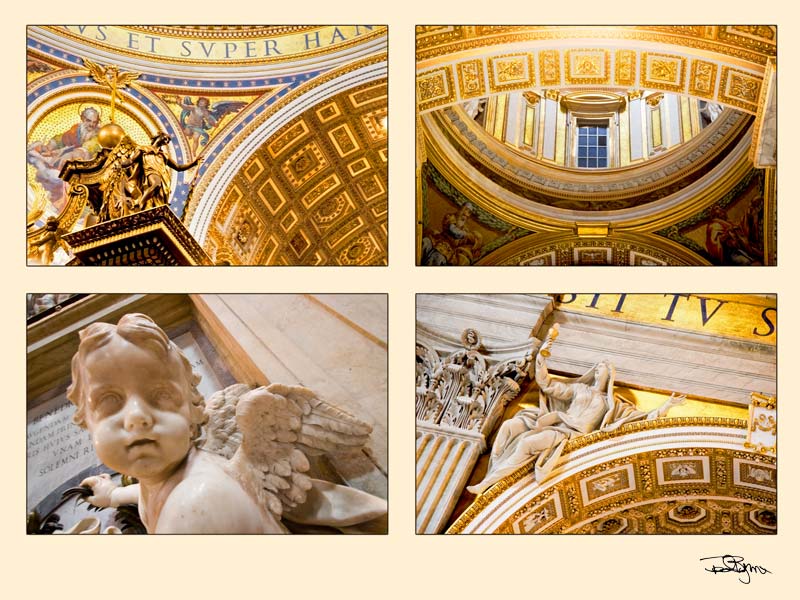
Yes, we dip into moments with our digital buckets and carry the light back with us. See here in this Triptych how I've done that? See the immensity, the awesome dimensions, the astonishing control of the artists who created all of this room out of rock hard materials? And imagine how they imagined, then executed their imaginings... I'm doing that as I examine St. Peter's Basilica at my leisure - for a longer time than I could possibly afford to be there in body, as opposed to being there in my mind.

Tuesday, November 6

Perspective

<- click here (if this image won't load, try clicking on the title word, "Perspective" above)
Yesterday I worried over how difficult it is to establish the dimensions of St. Peter's. Regardless of how often you've seen images of this space, you can't buy a wide enough angled lens to get the impression that happens when you walk through the door and look up! As you can see from these pictures, the room dwarfs people.

And I mentioned the size of these two angels that are part of this water fount. Still, even with folks next to all of these things... can you understand the heft of the sculpture? There must be a way to communicate the massiveness. Any ideas? There's gotta be some angle, lens, effect... whatever... that will do it, right? I just lack the imagination. Help!

Monday, November 5

Agape!

<-Click here
Before somewhere I've written about the scale of St. Peter's Basilica. Take for example the statue hanging on the arch of the image down there on the lower right. That object is about 18 feet from head to toe. It's astonishing that it was apparently carved from a single piece of marble. But even more amazing is the way the artist engineered it to fit up there. Imagine the force of this immense weight against whatever devices that were designed to hold it there. And imagine that the artist not only created the work from that single piece of stone, but also crafted it to match all of the engineering dynamics which were required to fit it and hold it in that position!

It is just a small part of a gargantuan archway. Holy Basilicas!

That angel on the lower left? I am six feet tall. It is about twice my size in every dimension and perfectly matches its twin on the other side of a holywater font. Again the two of them are somehow hung against that tribute plaque to a long ago Pope who commissioned the entire piece.

Behold the gilding all over this set. And except for the angel, all of this hangs forty to sixty feet above the marbled floors. The awesome grandeur of all of this defies photography. You step into this huge place and become agape.

I'm overwhelmed by conflicting emotions. Part of me is stunned by the combined talent on display another is appalled at the opulence of this seat of the Roman Church's piety. The thing is, you cannot absorb this scale, or the details. It's only as I sort out the these images and peer at the fragments that I'm able to begin to react to this cavernous space and what has been wrought within it. Wrought is a good word here. I find myself using words like wrought and behold. They are not words easily fit into conversations. But the place has got a whole bundh of serious wroughting done to it.

As I look at these images keep muttering... "Wow!" And wondering if any place now on earth is more extravagant than this. Anybody got a candidate?

---

GEEK STUFF: These images were all taken with my Canon EOS 20D on 10/4/07 at around 11 am: The lens was my 17-85mm (f4-5.6). While the effective focal lengths and speeds varied based upon a metering Mode set to Pattern, exposure bias 0, and processed in Camera RAW. Each image is presented full frame. Note that I do not use a tripod so these were all handheld at ISO 400.

Sunday, November 4

Meanings

><- Cick here
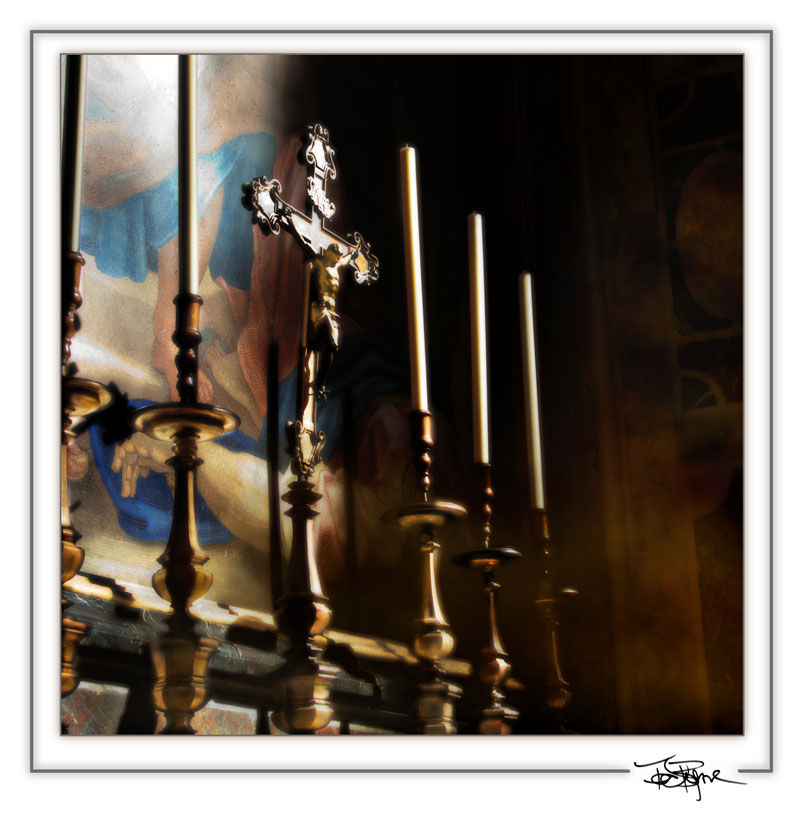
There are a lot of explanations for every photograph. I could write a caption for this one taken in St. Peter's that has to do with smoky incense and ancient symbols. Or about the loneliness of seldom used spaces in busy places. Or the caption might be about the perseverance of faith... The robustness of life... The edge where belief trumps proof.

It doesn't matter really.

Photographs have the ability to skip their reins: to pull free of their explanations. No matter how concrete the image appears to be, its meaning is as much a belonging of the viewer as it is the artist's. This is so far less the case with painting, or play-writing, novels, or sculpting. I wonder if photographs don't have more in common with music than with the demonstrative arts? Or if what we do is common with anything except, what we do?

GEEK STUFF: Canon EOS 20D, 10/4/07, 10:52 am: Lens 17-85mm, Focal Length: 33mm, Exp 1/13@f/11, ISO 400, Metering Mode: Pattern, Exposure bias 0, Camera RAW

___

NOTE: You may often find in-depth descriptions of this Italian visit among the comments-section below both as I add onto them and as you prompt my memory. I'll try to restrict my thoughts exclusively to today's image here on the home page and enlarge upon them in the comments attachments to a day’s posting as the discussions unravel. Those comments begin here. To follow the thread chronologically start at October 7th.

Saturday, November 3

Puzzling

<- Click here
During services at the vatican there is a side area where an elaborately dressed child wandered (this was a Thursday 10am mass, I believe). This image seems to have something substantial going on, but what? At first glance it seems little more than a snapshot, although I worked at the composition. Maybe it is just a snap... And yet...

Any thoughts? Anyone want to fill in a back-story to explain this moment?


GEEK STUFF: Canon EOS 20D, 10/04/07:10:49am: Lens 17-85mm, Focal Length: 64mm, Exp 1/25@f/5.6, ISO 400, Metering Mode: Patern, Expoure bias 0, Camera RAW

Friday, November 2

Steps To?

<- Click here
Around the corner from yesterday in Pompeii, some stairs. Sloppy masonry,no? Do you think that Malvinicus had a slave contracting service? I wonder how many sestares these things set somebody back? I also wonder how old they were when Vesuvius packed them away for our viewing pleasure? Did Romans look at them and say, "Ewwwww!"... old stuff. Or were they new arrivals, hardly used? Judging by the wear on the steps, I'm guessing they'd been around for a while and were part of the morning gridlock. I wonder what a Pompeii traffic jam was like? You think the slaves backed up? You think Malvinicus used traffic as an excuse for getting things done late?

Thursday, November 1

So What's The Deal With Old?

<- Click here
Here's a street in Pompeii. Old? Hmmmmm...

Suppose I sculpted two pigs out of marble. then suppose I wrapped one of them in plastic, stuck it into another marble, waterproof container, filled it full of those little non-biodegradable plastic peanuts used in packing, and sealed it tight. Then suppose I buried it. Two thousand years from now someone digs it up, opens the box, pulls away the plastic and looks at my pig.

Back to the other pig. Remember, I didn't do anything to protect it, just let the elements age that little cutie. Now, should the digger-upper be able to compare that unboxed, unwrapped piggy... with its twin: which would be older? Which would seem older?

"What difference does it make... the "seem" thing, Ted?"

Glad you asked that. Pompeii was packed in pumice. Some parts of it look about as old as the ruins of the Bayan Plantation's mansion in Hilton Head, South Carolina. They've been crumbling for about a century and a half. I could post a picture of them which looks every bit as old as this Pompeii street. Maybe older.

So, what's old got to do with it? What is the fascination with Pompeii?

"Well gosh Ted, it's like a telephone connection back 2000 years."

And your point is? I mean, what is the romance that surrounds the merely old? Do we need it to invent stories like this one I told a while back?


Why are we surprised that people who were biologically identical to us were able to build streets, walls and doorways? Of course I felt a certain reverential awe on that street in Pompeii. But the stark juxtaposition of this radiant modern sign against the walls which time and pumice scoured almost free of color caught my attention more dramatically than the street itself.

So... what is the lure of things that seem old? How do they speak so grippingly to the human condition that we stare... the same way we stare at zoo animals? Is that it? Are Pompeii and the battlefield at say Gettysburg sort of like giraffes that we can visit? Or is it the people who we imagine walking down this street who are really the giraffes?

Perhaps it's amazement that attracts us to old things. Are we amazed that they left buildings which look so much like things we can build, or are we amazed that they stopped building them? Or do we sense that there are answers here to questions we find hard to ask?

Fact is the Roman Civilization failed. We have rebuilt their burnt out culture. Have we done a more permanent job? Or will our ghosts be someone else's giraffes or scuplted piggies in a time long long to come, and far far away?

___

GEEK STUFF: Canon EOS 20D, 10/03/07:5:14 pm: Lens 17-85mm, Focal Length: 26mm, Exp 1/60%5.6, ISO 200, Metering Mode: average, Expoure bias 0, Camera RAW

NOTE: You will often find in-depth descriptions of this Italian visit among the comments-section below both as I add onto them and as you prompt my memory. I'll try to restrict my thoughts exclusively to today's image here on the home page and enlarge upon them in the comments attachments to a day’s posting as the discussions unravel. Those comments begin here. To follow the thread chronologically start at October 7th.

Wednesday, October 31

Cheek Turning

<- Click here

Alfred Stieglitz in 1909 observed that photographers, "Depict life in scraps and fragments." Some have argued that the painter constructs a concept while the photographer on the other hand discloses it. Today I think the photographic artist can both disclose and construct with decisive fragments. Hmmmm... constructive disclosure? Have I invented a term? Cool.

In fact we tend to find pieces of life. And in a way by revealing just that piece in its context, we disclose something unique. Something we saw. Here I noticed a raging saint in a place built upon the idea of peace, love and turning the other cheek. Even though this is a fragment from St. Peter's, the warrior has a role at this Basilica.

Photographers can wrench things from their context. Is that what's happening here? Or is this fearsome sword an important pat of the function of this place? Hmmmmm.... I wonder?

Tuesday, October 30

Rita's Birthday's On Halloween

<- Click here

October 31st is my wife Rita’s birthday. I love her more today than ever. When I found these marbles in a Florentine shop, their sparkling luster reminded me so much of what a wonderful woman I married. There’s something magical about the durability yet seemingly accessible fragility of that substance along with the astonishingly delicate forms it can take.

Her love for this place of her ancestors plus the gem-like stone with which they did so much convinced me that I’d found this year’s birthday card.

Happy Birthday Honey.

Monday, October 29

Beneath The Surface, What?

><- Click here

In the papal tombs under St. Peter’s you walk through corridors, tunnels actually, which open onto rooms. Some are behind glass, others behind ropes. Each is a display. And you see a surface like this where tiled arches hide caskets behind tiled frescoes of a number of papal bodies and perhaps in the center of a room is a sarcophagus like this displaying a grandly carved marble of a pope in death’s repose.

Is it grisly? Is it reverent? No, and no. At least not for me. What it was was a surface. But the speed of the people-line gave me no time to interpret or intuit what the reality must be if it looked like this. I’d hoped that if I made a photograph that captured that surface that later, like now, I’d find the time to penetrate this presentation. To work out what this Vatican culture’s message was.

But as I processed this image of Ambrosius on the wall overlooking one of the Piuses in marble there was too much information hidden away. Too much history between these two men that had vanished like a bridge gone into the mists. I have no idea why they lie so near to one another. What grouping this represents. I sense no pattern , only pomp and astonishing wealth. And again, I wonder if there is something here which will take me to the meaning of piety: or if this surface acts more as a curtain than a window to understanding what piety means?

___

NOTE: You will often find in-depth descriptions of this Italian visit among the comments-section below both as I add onto them and as you prompt my memory. I'll try to restrict my thoughts exclusively to today's image here on the home page and enlarge upon them in the comments attachments to a day’s posting as the discussions unravel. Those comments begin here. To follow the thread chronologically start at October 7th.

Sunday, October 28

When To Sign A Photograph?
• An Essay

The last time I was in Rome…. Gosh that’s a cool sentence, it rings like a fork against fine crystal. “Twinnnnnnggggg!” But anyway, the last time I was in Rome we, like every other Roman tourist who ever lived, we visited St. Peter’s Bascilica at the Vatican.

And like every one of them, I took pictures. Here’s one, which I haven’t - and won't - sign.

><- Click here

Why is that? Because this image was actually taken by the engineers at Canon Industries. What I brought to this image was their EOS 20D camera and a standard zoom lens. What I contributed was a lifetime of work that let me save enough money to take the Canon stuff and myself from Lancaster, Pennsylvania to a spot in the middle of the massive stone square in front of the Cathedral.

Photographers have wrestled over four things that a camera can do. They anguish over whether an image they “take” is objective or subjective. And they sweat over whether it demonstrates or illustrates.

Say what?

Lemme ‘splain by example. This picture I’ve shown you demonstrates what this view of St. Peter’s looked like on a mid, very sunny, October day. Except for earning the ticket and the camera paraphernalia, my only contribution was to point and click. And what I took was what people all around me were taking. It is an objective demonstration of what you would have seen if you stood there at that time. Get it? Objective (there is little if any of “me” in the picture I took) so while it demonstrates exactly what was in front of me, it fails to illustrate anything about the thoughts or feelings it invoked. I bring nothing to this.

Canon ‘took’ this picture; I did not ‘make’ it.


For me to sign it would be actually vulgar. Who am I to claim any credit for St. Peter’s Basilica? What I brought to this photograph was the mindless craft imbedded in a Canon camera and its lens. Now, I am not dumping upon craft, merely recognizing if for what it is in photography. For me to claim any sort of ownership for this image would be as if I opened up Shakespeare, photocopied a bunch of lines, and then grabbed credit for them. Just as that is the act of plagiarizing someone else’s ideas, claiming credit for a found image is also plagiarizing. And it doesn't matter if you are slavishly copying Renaissance architects or artists, or in some other case plagiarizing nature by displaying an un-processed snapshot of a sunset.

Notice I wrote, “un-processed.”

Artists process. They bring their ideas and feelings to the making of a photographic image. The picture they make, as opposed to pictures snap-shooters take, is a subjective illustration of them. And processing can happen before, during, and after a photograph is taken. Processing demands some intellectual intervention.

But let’s go back to the last time I was in Rome… “Twinnnnnnggggg!”

My first thought was to convey a sense of place: to communicate the classical grandeur and mass of this space in front of the seat of Catholicism. How to say, “Holy Basilica, Batman! This place is HUGE, OLD, and RICH!”

So I did this.

<- Click here

See, here’s a triptych which taken together as a totality conveys through details what I couldn’t do in a single vista. Why couldn’t I? There were a zillion people all around me that seemed to be that many distractions from this place. Now they also could have been the subjects of a different idea, but it wasn’t the one that overwhelmed me. Plus the mid-day light is a photographer’s nightmare searing contrasts across marble, which no camera can hold throughout the tonal range. I also dealt with them by my points of view and processing.

Traditionally photography was governed by technical standards that made genuine achievement hard to accomplish. Unlike a poet or painter, I have a machine between my ideas and the thing I have ideas about. That machine’s the creature of strict engineering principles. Until the birth of digital enhancement, every action I took to offset one of the machine’s limitations, every one of those things (lenses, filters, formats, chemicals, papers, lighting, makeup, costuming, whatever…) resulted in corresponding intrusions upon the final result. Everything a photographer did to ‘make’ an image was a work-around that left its own shadow.

Great photographers came to master those enhancements in both pre-processing (getting the right equipment to the scene) and post-processing (usually in the darkroom, but sometimes later with razors and hand applied coloring… like that).

My triptych is essentially quite traditional. Through the careful selection of viewpoint, lens, aperture, speed, polarizing filter, and some digital darkroom enhancements I selected three full-frame images that together communicate my awe at the size, age, and wealth of this place. Together they form a subjective (my own) illustration of how St. Peter’s front stoop impressed me. That’s what I’m telling you with this trio. Hence it is no longer vulgar to sign it, indeed while I have difficulty signing any of the parts individually (for the same reasons I wouldn’t sign the first image I posted up there) the trio of parts is my statement, not Shakespeare’s not a Renaissance architect’s… Mine. Ted Byrne’s.

When an image conveys subjective ideas to illustrate a feeling or an idea (or both) it transcends craft… Goes beyond it. That’s art baby (um, whether it’s good art is never the artist’s call). There are still photographers who cannot believe that what they do in an instant can possibly be art. After all, how long did it take Michelangelo to release David from that block of marble?

Art isn’t measured in time put in. If it were then all you’d need to judge its existence would be a stopwatch, clock, or calendar. Many photographers seem to feel that art making is something pretentious. No, they argue that they aren't doing art at all, merely finding, recording, observing, witnessing, or measuring. And photographs can do all of those things in science, in court, and even on occasion in photojournalism. And they can do them better than any other representational craft.

But they can also illustrate ideas and feelings. Photographs can be as fictional as the works of Thomas Wolfe, Tennessee Williams, or Ingmar Bergman. In fact, Bergman used cameras exclusively to tell his feelings. No one objects to any of those doers of fiction signing their work.

In photography the subject always bleeds through. And when the subject matter seems to dominate the subtlety of the artist's layering of emotion or thought – it seems pretentious to find a signature on the photo, right? The subtler-seeming the photographer’s enhancements, the more likely the viewer is to mistake an image for an objective, point-and-shoot representation rather than a deeply personal subjective illustration of the meaning which the artist conveys. The fewer seams that show as a result of stunningly hard work the less likely the photographer is to get credit for the artiness of the work. Odd, I can think of no other area where that kind of rule applies.

Imagine if the smile on the prima ballerina were taken to indicate that her art were effortless and therefore banal. Imagine if the virtuosity of a violinist or the technique of a sculptor led people to conclude that they were incapable of communicating feeling, or thought!

So, do we stop here? Can a photographer only make signing-worthy photographs when they are in groups like my triptych? If that were so, then the only photographic artists would be some sort of time-lapse cinematographers. Which brings me to this image.

<- Click here

Once again, I stood out there in front of St. Peter’s at the same time I both took the first image and when I made the triptych's pieces (notice the “took” versus “made”). But this time I wanted in one frame to create a piece of illustrative art. I wanted you to understand something about me, and how I began to look at St. Peter’s. I wanted to convey the rich color of medieval pomp. The contrast between the softness of flowing time (water) and the solidity of wealth (the immutable structures). I wanted your imagination to embrace one idea, “opulence” in contrast to another “piety”. And I wanted you to wonder if the two might really co-exist or if they were mutually exclusive. And if so, at this place… which one won?

And I wanted to capture your attention with technique, palette, and strict composition. But most importantly I wanted to create … to make… an image you could look through to find these ideas and feelings.

Now, it is quite arguable whether I succeeded. But it is not arguable that the final image is one that is unique to my mind at that time. It is a subjective illustration of the way my mind wrestled with those things. I did not plagiarize Shakespeare or that Renaissance architect with a click of my shutter. Canon did not take this image, I made it.

Which means I can sign it as proudly as any artist signs his work.

From their first years photographers wrestled with a feeling of artistic inferiority which painters in particular were happy to reinforce. One would think that photography’s claim to art making had been settled long ago. Yet I believe it’s a lingering sense of insufficiency which leads photographers to the conclusion that signing their work is either vain or coarse.

It is the making of photographs into illustrative art which proves that photographers have the same license to brand their creation as any other artist. Which explains why I sign most of the images I post here, including this third image I built from the last time I was in Rome… “Twinnnnnnggggg!”

Saturday, October 27

Fountain Of Thought


<-Click here

Nine Disputable Facts Of Life

As a writer, I keep note of things that occur to me in discussions, when I’m reading, or when I’m just sitting and contemplating a fountain like this in the gardens of the Vlla D’Este (which I discussed yesterday). Looking at my notes, I found that I mulled over three-quarters of a dozen that trundled through my mind like those melodies which you just can’t stop humming.

So okay, let me get them out of my head and into yours. I have no idea whether they are right or wrong, good or bad – and I cannot promise they are all that original, but I hope you’ll agree, they each seem worth kicking about to see if anything worthwhile scurries out from under, eh?

1. Happiness cannot be caught by pursuing it.
2. Rights are not requirements.
3. In fact most rights are often more demanded than needed.
4. You can never be offended against your will.
5. No faith is reasonable, all faith is passionate.
6. Defining poverty as a virtue therefore makes wealth a vice.
7. Almost any act, no mater how dreadful, can be explained away by appealing to its consequences.
8. Before the nuclear missile we could wait for reason to catch up with passion.
9. Parenting and breeding are different things. One of them is hard.

Friday, October 26

Chilly?

<- Click here

Beyond Rome in the hill town of Tivoli sits the Villa D’Este built by the Cardinal Ilppolito il d’Este in the mid 1500s. Travertine marble comes from Tivoli’s hills, its abundant tumbling water supplies some of Rome’s electricity. Tivoli's slopes are covered with olive orchards,vineyards and gardens.Some fine papers are manufactured there.

Cardinal Ippolito II d'Este (1509-1572), was the son of Alfonso I d'Este and Lucrezia Borgia and grandson (!) of Pope Alexander VI. He was appointed Governor of Tivoli by Pope Julius III. The villa's known for its opulently restored splendor and particularly for majestic gardens resplendent with enormous fountains that are entirely powered by natural water flows (no pumps). They are both an artistic and engineering amazement. Cardinals, unlike many hundreds of the priests who they ruled, quite apparently failed to take a vow of poverty, eh?

A central fountain (Of the Great Cup) has water issuing from a seemingly natural rock into a scrolling shell-like cup. Sadly the lighting was so awful in the mid afternoon of a searing day that there was no interesting way to picture the fountains. But the internet’s replete with photographic tours through the villa and its gardens.

Frankly though, it was the details of the place which flaunted the lavish wealth of the Cardinal/Prince of the Roman Church. Look at this one travertine detail on the fountain executed by the incomparable Bernini. See how the face looks more like an illustration from a modern comic book than a medieval hero? Look at the eyes and the very real expression. There’s nothing calm or idyllic – this guy is worried and I think damned chilly standing all those centuries naked in the water-logged air.

Thursday, October 25

Does Everytime Face A Vesuvius?

><- Click here
Is there a Vesuvius always waiting just down the lane? Is there a force so potentially dreadful which some gentle Summer day might erupt over all or any of us? Does it wait over there looking mellow yet very very large?

On that August 29th in 79 AD this view was abruptly different. That mound at the end of the lane burst upon every plan, dream, and aspiration in Pompeii. It causes us to wonder whether there’s a force so potentially dreadful that some peaceful day can erupt all over any of us? Does it wait somewhere overlooked until it stops time? Should we concern ourselves with what we cannot possibly control?

And even if a personal Vesuvius lurks somewhere, does that lessen our responsibility to control what we can? To create, prosper, share, and succeed even in the shadow of inevitable things?

You wonder about that as you look down this ancient street at a primal force so massive, yet so wickedly calm.

GEEK STUFF: Canon EOS 20D, 10/03/07:4:38pm: Lens 17-85mm, Focal Length: 56mm, Exp 1/12@f/7.1, ISO 200, Metering Mode: Pattern, Expoure bias -1, Camera RAW

---

NOTE: You will often find in-depth descriptions of this Italian visit among the comments-section below both as I add onto them and as you prompt my memory. I'll try to restrict my thoughts exclusively to today's image here on the home page and enlarge upon them in the comments attachments to a day’s posting as the discussions unravel. Those comments begin here. To follow the thread chronologically start at October 7th.

Wednesday, October 24

Temple Of Isis

<-Click here
Multi flavored adoration was as much for sale just off of the streets of Pomeii as in any modern city. It was hard to walk more than a block without finding a different brand of faith. Is there something within us which simultaneously hunts for a divine solution to our challenges but demands that our personal solution be different from the suspiciously superstitious beliefs of the next guy?

The religious wars apparently flourished in Pompeii and exotic foreign faiths like this temple to the Egyptian diety Isis sat close to churches channeling the gods of the Romans and Greeks. Today in the West there seems to be a more consistent agreement upon which god to adore, but now the devil is in the details, eh?

---

NOTE: You will often find in-depth descriptions of this Italian visit among the comments-section below both as I add onto them and as you prompt my memory. I'll try to restrict my thoughts exclusively to today's image here on the home page and enlarge upon them in the comments attachments to a day’s posting as the discussions unravel. Those comments begin here. To follow the thread chronologically start at October 7th.

Tuesday, October 23

Claudio Marcello's Font


<- Click here
In 67 AD a massive earthquake jiggled the prosperous city of Pompeii, cracking walls and massive marble columns leaving debris everywhere and challenging its people and the Roman empire to begin a major cleanup and restoration job. It was still underway on the mid day of August 29, 79 AD. See the repairs to the walls in the back ground of this image, and the gouges in the columns?

On that day in August Pompeii’s name became inextricably linked with another name… Vesuvius. Along with the smaller city of Herculaneum, Pompeii was startled at first then buried in layers of silt which carefully preserved its history up until 79 AD.

Over the last three centuries excavators have revealed places like Claudio Marcello’s gift to his city of a public square.
>I know it was Claudio Marcello from this curiously preserved marble plaque with his name as its patron (note how the plaque’s carver ran out of room on the right). Marble work which matches this font is once again basking in the mid-day light about two thousand years after the still smoldering Vesuvius stored this vessel away for us to enjoy.

By the way, Vesuvius will erupt again, and if the winds are the same, Claudio Marcello's square will get packed away once more.

Sunday, October 21

Emotional Charge

<- Click here
Have noticed how quickly we lose interest in a picture? Our attention even toward a great one that embodies a large slice of the artist's effort, ideas, personality, and feelings quickly becomes flat. And yet, if we return to it days, months, and even better, years later - somehow it glimmers again. I wonder about that because it doesn't seem to happen with other sorts of art which may hold our attention initially for longer, but once lost, rarely regain it.

Here's a Roman street scene. It is entirely typical of a life-moment within the walled city. See the street? The sidewalk? The walls, the ancient arched doorway? And the tiny shop spilling over with fruit and flowers? And packed in tight against it is a scooter. The elements are all there. Here's what Rome looks like. It looks different from Seattle, Davenport, Springfield, Atlanta, and Lancaster. The pieces add up to an explosively colorful moment. It is charged with the casual effort of the shop owner who assembled this atop the millennia-old streets, in front of the walls first built just as long ago. This is the outdoor day-time furniture of Rome in October. I suspect that it will strike your fancy today: become forgettable in moments, and yet... if you should return to it in a couple of years, or decades from now, I'm guessing it will be at least more interesting then.

Why is it that photographic images are like that? It's a mystery.

Saturday, October 20

Not Pompeii: Almost

<- Click here
"Photographs give people an imaginary possession of a past (or place) that is unreal..." - Susan Sontag

Controlling the light is a battle that's normally lost to the traveler. In the case of Rome, obstacles made it impossible for me to arrive in the city much before 11am... HORROR CONTRASTS! Which means from the bleached out lemon light, I had to make lemonade.

Romans hang their laundry: an old-fashioned custom until you realize that their daily warm sun make clothes dryers a careless waste. Still, hanging lines with pennants of vivid clothes a-flutter are a charming time-trip to memories of cities where human wisps smudged the harsh lines of modern metal and crystal angles.

This scene of the lady-with-pearls was a perfect memory which I never had of a past-place except, damn! The mid-day sun which warmed her clothes was was dreadful. Which brings me to Pompeii (a place I’ll revisit here maybe next week).

I took some shots of two-millennia old walls from that recovered city. And as I looked at the Lady-Of-The-Laundry, Susan Sontag’s words careened through my head. “Hmmmmm,” I muttered. “What if…. What if this women was doing her daily hanging there, on the day before Vesuvius went, WOOOMP! What if the stone walls broke up that light? What if…..”

NOTE: You will often find in-depth descriptions of this Italian visit among the comments-section below both as I add onto them and as you prompt my memory. I'll try to restrict my thoughts exclusively to today's image here on the home page and enlarge upon them in the comments attachments to a day’s posting as the discussions unravel. Those comments begin here. To follow the thread chronologically start at October 7th.

Friday, October 19

Why Not A Post Card?

<- Click here
How many galoots with Instamatics took this picture from this same bridge looking up the Tiber toward Adrian's Tomb? Why did I take it? I just saw a similarly shabby version of it in a ghastly written article in this month's Photoshop User Magazine. Do you realize how much I could have saved by just scanning that thing instead of schlepping off to Rome? I can think of no way to pull something original out of this cliché.

Can you? Hulp?

NOTE: You will often find in-depth descriptions of this Italian visit among the comments below both as I add onto them and as you prompt my memory. I'll try to restrict my thoughts exclusively to today's image here on the home page. Those comments begin here. To follow the thread chronologically start at October 7th.

Thursday, October 18

A Bit Of Gandolfo

<-Click here

Physicists tell us that bits are the universal medium of communication. And physicists might be the smartest scientists (at least that’s what they tell me). So how to communicate the Pope’s vacation palace at Gandolfo? How about in a bit? A tiny piece of a big field that combines the architectural grandeur, with the pomp and two men at the very foundation of Papal authority… two non-coms: a soldier and a priest.

A violinist friend of mine, an amateur musician, once found herself at a reception for present and past violinists of the Philadelphia Orchestra. She told me that she felt like a priest at the Vatican.

Well, here's that priest.

And here is one bit of wall, soldier and priest: a trio that condenses two millennia of heirarchy and grandeur into a narrative I can understand.

BTW, for you metaphor collectors, how about that slope?

Gandolfo, Italy. 10/01/07:11:40pm

NOTE: You will often find in-depth descriptions of this Italian visit among the daily comments below both as I add onto them and as you prompt my memory. I'll try to restrict my thoughts exclusively to today's image here on the home page. Those Italian comments begin here.

Wednesday, October 17

2007 Award Winner - Super Sorprese & Trip Notes

Note: Accepted as one of theworld's finest People Images of 2007 for Canon POTN Book to be published in the Fall of 2008.

<- Click here

Shocked: Tessio watched Umberte make the signal.

Rome, Italy. 10/01/07:12:09pm

---

BACK-STORY: As some of you know, Rita and I travelled to Italy with Beth and Chris Herr, October 1 - 14. The first week we were based in the Albian Hills south east of Rome, the second week we were in an apartment along the Arno River in Florence. We took day trips to Tivoli, Pompeii, Spoletto, Sienna, and Assisi, and a part of Naples. I took approximately 18 gigs + of RAW images. Rita took another 2 gigs of jpgs. At first I backed up the images each day on: my MacBookPro, a portable external HD, and on an iPod. However on October 8, the MacBook crashed and from there we kept everything on Compact Flash cards. No images were lost.

On the evening of October 8, master photographer Andreas Mannessinger & Irene drove down from Vienna to join us in Florence for wonderful dinner at the Nanamuta Restaurant, and the next morning we met at Sunrise to begin a mano-a-mano shoot at the Duomo and then worked our way through the winding ancient streets to the Ponte Vecchio (see my posting for October 7, the day before the MacBook crashed).

I'm slowly working my way through the images in chronological order (with the one exception of October 7) - and it's so much like reliving the trip and its ideas and feelings. I hope you'll enjoy this after-the-fact journaling as I match my notes (I always carry a small spiral bound notebook) to the pictures. Eventually we'll get to the results of the photo-shoot with Andreas (note, he's already posted a spectacular image from that morning - that includes a sort of portrait of me at work - which you'll find by clicking here.).

A last point: In a couple of days, I'll give you the names and contact information for the places we stayed and our hosts (along with pictures). Both the Byrnes and the Herrs will recommend them enthusiastically.

---
NOTE: You will also often find in-depth descriptions of this Italian visit among the daily comments below both as I add onto them and as you prompt my memory. I'll try to restrict my thoughts exclusively to today's image here on the home page. Those Italian comments begin here.

Tuesday, October 16

Living With Dead

<- Click here

When you’re young they say that the days go on forever and death’s little more than a rumor at the end of the road.

In southern Italy’s small towns they paste wall banners memorializing anniversaries of the passing of loved ones.

NOTE: You will often find in-depth descriptions of this Italian visit among the comments below both as I add onto them and as you prompt my memory. I'll try to restrict my thoughts exclusively to today's image here on the home page. Those comments begin here.

Monday, October 15

Wall Whisper

<- Click Here

Susan Sontag wrote, “Photographs (can) give people an imaginary possession of a past that is unreal.” She goes on to suggest that photographs are, “a way of certifying experience.”

The walls of Castle Gondolfo reflect both the implacable force that Urban VIII breathed into them in 1624, and the current fashion of genteel seediness which coats their façades in crackling layers. From the image we can we grasp either the enormity of the past power of the men who peered down from this window upon Lake Albano, or the situation of its current tenant. Is this a photograph of a past, a present, or a future?

As I leaned against the afternoon warmth of this wall, it was like a rock. And see the etchings in the stone window frame? Beneath your fingers they’re as crisp as yesterday, the artisan’s message left there at the end of a day some four centuries ago.

Odd how imagination’s so one-way. Beneath my fingertips I could feel what his hand felt as it wiped across this surface. And I can picture him packing tools, walking a cart half a block to the town square, getting wine, and wondering where his next job would take him.

I can imagine all of that, yet I cannot image the guy who might come upon this little story in 2507, yet he will know as much about me as I do about the man who made Urban VIII’s window.

We are all something's history.

NOTE: You will often find in-depth descriptions of this Italian visit among the comments below both as I add onto them and as you prompt my memory. I'll try to restrict my thoughts exclusively to the image here on the main site. Those comments begin here.

Sunday, October 14

Look! Up there... Castel Gandolfo.

<- Click here

NOTE: You will find in-depth descriptions of this Italian visit among the comments below. I shall try to restrict my thoughts exclusively to the image here on the main site.

Castel Gandolfo, the Pope's vacation residence, occupies a height in the Alban Hills overlooking Lake Albano about 25 miles South-East of Rome. The lake was formed when an ancient volcanic mountain collapsed. The castle was made part of the few remaining Papal holdings when the ancient power of the Popes in Italy collapsed. It sits amidst a small town in Lazio. Gandolfo shows the wear of time and while a patina of grandeur peeks through it seems to present His Holiness with the same challenge faced by all owners of old homes... The word "money-pit" resonates, eh?

I suppose the Pope is faced with a dilemma. Should he let the facade, at least, deteriorate so as not to seem to be detouring the gifts of the faithful toward maintaining an ancient opulence while millions go hungry or die from preventable diseases (diarrhea comes to mind)? Or should he restore the place to its former glory to show the significant might and influence of the Roman Church? Not to decide it to decide, eh?

Sunday, October 7

This Place Looks Like This

<- Click Here
Hey! Here's a fast postcard to all of you from Firenze, Italy in the pre-dawn of this AM.

Wish you were here...


Ted

This image is posted from our apartments in Florence on the evening of my Mano-A-Mano photo shoot with Andreas Manessinger. I've only quickly had time to look at the four gigs of shots I took at the Duomo and then down the ancient streets to the Ponte Vecchio at sunrise this morning. I'll probably not get back to these for weeks. But it looks as if I have an image or two that are competitive.


This is the 365th posting to ImageFiction!!!! So? Is this really the first anniversary, or just an indication that I needed a day off here and there over the past year? Hmmmm.....