Showing posts with label Africa. Show all posts

Saturday, April 11

Morocco VIII: What's A Ksar and Why?

February 13, 2020
As always, click upon any image to enlarge it

Plate 64

The highway toward Marakesh from Ouarzazate winds through craggy southern slopes of the  High Atlas mountains cut deeply by the Ounila river.


Plate 65

A half hour into that Valley the town of Ben Haddous sits across the river from ruins of the Ksar Ait Ben Haddous. Every North African town has a mud and straw kasbah. This one, nestled against the mountain slopes, is among the most impressive. 

Plate 66


*****

Built around one of the steeply abrupt rocky hills that dot these vallies, Ben-Haddous's surrounded by an array of farms, mountains, and rivers. It’s believed that the town, as opposed to the Ksar, was established in 757 and that its founder, Ben-Haddous, still lies buried in his tomb behind this  decaying walled city. The site was also one of the many trading posts on the commercial route linking ancient Sudan to Marrakesh by the Dra Valley and the Tizi-n'Telouet Pass.

*****


Plate 67


*****

The Ksar of Ait-Ben-Haddous is an ighrem (fortified village) along the former caravan route between the Sahara and Marrakech. The word ‘Ksar’ refers to a large group of close-together kasbas (homes) and barns behind defensive city walls which are reinforced by corner angle towers and pierced by two baffle gates.

*****


Plate 68

*****

Unlike the town, but like Ouarzazate’s seraglio (See Morocco VI), the oldest ksar constructions do not appear to be earlier than the 17th century. However their structure and technique were propagated from a very early period in the valleys of southern Morocco. The site was also one of the many trading posts on the commercial route linking ancient Sudan to Marrakesh by the Dra Valley and the Tizi-n'Telouet 


Plate 69


Ksar Ait Ben Haddous is around 1,300 square meters. Made of red clay bricks, it has many long and narrow alleys tangling up in a unique geometric shape. Some structures are modest, others resemble small urban castles with their high angle towers and upper sections decorated with motifs in clay brick - but there are also community areas which include a mosque, a public square, grain threshing areas outside the ramparts, a fortification and a loft at the top of the village, a caravanserai, two cemeteries (Muslim and Jewish) and the Sanctuary of the Saint Sidi Ali.

Plate 70


*****

Plate 71


The earthen buildings are very vulnerable due to lack of maintenance and regular repair resulting from the abandonment of the ksar by its inhabitants.


*****

Plate 72

*****


Plate 73

*****
About 98 families lived in the Ksar until the 1940s. Nowadays, only five still live. there, most moved to modern structures in the bustling town across the river. The large houses in the lower part of the ksar however, with well conserved decorative motifs, are regularly maintained. Workers return daily however to shops that serve the entire area’s lively-hood: tourism and the movie makers from Oouarzazate.


Plate 74

*****

Plate 76

*****

The architectural style has adapted to the climatic conditions all in harmony with natural and social environment configurations.  The inclination during restoration to introduce cement has so far been unsuccessful. Only a few lintels and reinforced concrete have escaped vigilance, but they have been hidden by earthen rendering.

Plate 77
Note the graffiti on the front of this shop. This was a set for the movie Gladiato


*****

Plate 78

*****
Scholars conclude that Ksar of Ait-Ben-Haddous represents the Berber culture of southern Morocco, which itself has become vulnerable as a result of irreversible socio-economic and cultural changes.


Plate 79

*****

Plate 80
Up next - Morocco IX: Marakesh 


Sunday, March 29

Morocco VI: On The Road


Circa. February 11-13, 2020
As always, click upon any image to make it BIG!

Morocco appears to be a place of dueling paradigms. As I’ve written, it’s a highway along which cultures moved each moulding what they’ve found along their way. It’s customs are a gift of its landscape. Today Arab/Muslim totems form a shell that’s kneaded by current and historic European and African ways.

Virtually everything in life is a product of cultures and customs coming from very different places. That tradition appears to have created opportunities for Morocco to drill a hole into barriers to change. Much like Turkey, which has acted as similar bridge for mass migrations, Morocco’s secularized its way of life particularly in its modern cities. 

What happens when two historical cultures collide? 

How much can a tourist learn about Morocco through a bus's window? At rest stops? Lightening tours through road markets or tourist stops? Or quick-walking the streets of a town to leg-stretch? Do we learn or merely clot feelings together into a harebrained heap? I dunno. Let's see.


It's a nine hour bus ride from Erfoud to Ouarzazate back down through the Atlas Mountains and across the cultivated Draa valley. Verdant? In reality, much of Morocco is desert. But snowy peaks collect on mountain tops and then melt to fill some creeks and underground aquifers and there's sufficient rainfall near to the coast to supplement the runoff. 

Millennia ago Moroccans learned how to tap those underground flows, unplugging them with wells and pipes then letting gravity irrigate fields of wheat, olives, dates, spices, nuts, fruits, and tomatoes. Yep, you've noticed in the images so far from this shoot, how similar Morocco looks to the U.S. Southwest, right? 

See Hank Rettew up there in his Clint Eastwood pose? Actually the engineer was studying a deep well whose weathered support-apparatus looks eerily like the ruins of native American workings in Nevada, New Mexico, Utah, or Colorado. How come? Shrouded in prehistoric mist, lies an explanation.

Plate 43

Look at any world map and you'll see how South America fits neatly into the African coast line. Geologists tell us that both the Americas, Europe, and Africa were once joined into a vast Oceania that ripped apart to ride upon plates to their present global positions. Which might mean that Africa's upper western tip nestled neatly into what's now the Gulf of Mexico so that the geologies of the two regions match. Look at the image above. Can you imagine 1950s Western movies  filmed there filled with cowboys, stage coaches, and teepees? 

Similarity of climate and geology have lent to the exploitation of identical building materials - largely adobe rectangles  - which dot both the North American Southwest and the rugged countryside of Morocco. Geologists love Morocco... and so do fossil collectors since much of this area was, as was the U.S. Southwest, undersea during the wanderings of tectonic plates. 


Plate 44

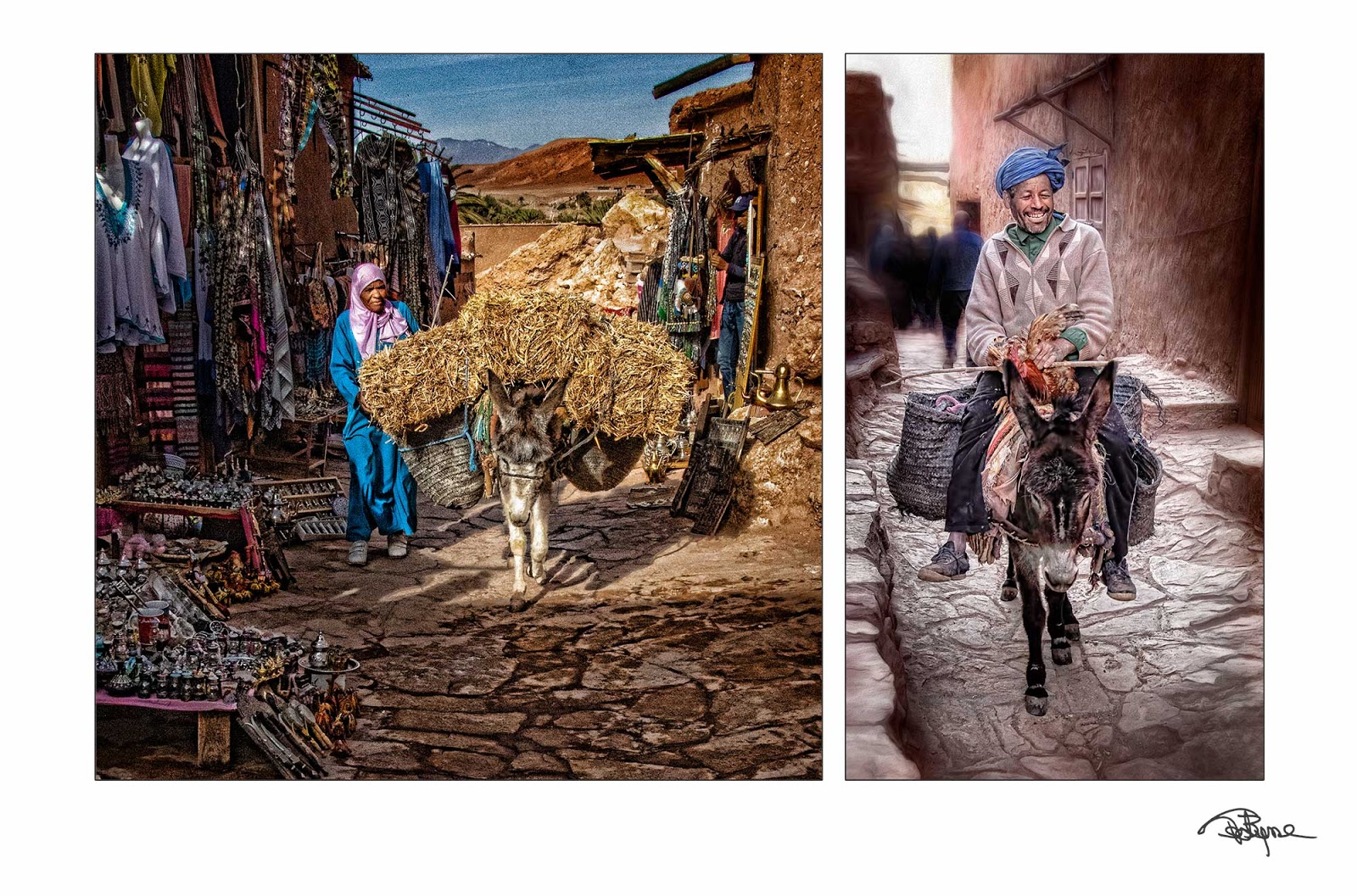
The rugged countryside allows for hard-scrabble subsistence and larger estate farming: Many feeding country markets along the route or selling their handcrafted rugs and jewelry through a valley of hooded men.

Plate 45

Plate 46
Plate 47

Here's where the Sahara inexorably encroaches along the valley's edges. It’s where nomads stop for a while to raise donkeys and some livestock. Does this guy wonder each morning if this sunrise will mean the last of rainfall here on the edge of land's end? Hmmm...

Plate 48

The immense plates continue to shift beneath Moroccan’s feet - quaking down the adobe villages. The waves leave behind eerily empty bands of structures surrounding new, hopefully, sounder construction. These abandoned strips are like rings on a tree marking the times between vicious quakes which reproduced disciplines of scarcity. 

Plate 49

The new walls though are built around memories of ancient Berber and Arab design. As if a lost-wax method was used to pour the new around a mimesis of history or legend. And the core of the matter is always about changing customs. 

Plate 50

For example, notice how the Hotel Rosa is designed around the Moroccan style, yet it lacks any Arabic writing.  Now, look carefully at The Komar Lounge up there. See the signs above each doorway. Intriguing how twin cultures mesh here, yet don’t.  Is there a wall between the two interiors? I guess to the left they eat, drink, dance and be merry.... While on the right they eat and be merry? Morocco's - a place between - whose people have adapted since way before Carthage ruled them.

Plate 51

It's continually restructuring atop the leavings of the past. Here ancient ways meander through modern tag sales.

Plate 52
One thing's clear on every Moroccan street. Customs are a residue of coping, and men are allowed to transition more quickly than women. 

Plate 53

Are there lessons from the other side of a bus's windows?  More likely there are only feelings which we filter through whatever it is we bring to a place.

Coming soon: Morocco VII: Ouarzazate: Africa’s Hollywood


Wednesday, March 25

Morocco V: The Sahara


February 11, 2020
As always, click upon any image to make it BIG!


Plate 30
We bussed through the Atlas Mountains to Erfoud on the upper zag of Morocco’s zig-zaggy western border. It's just east of one of those spots where the country zigs into the world’s mysterious desert. The Sahara’s a big hot rocky and sandy thing… large enough to cover the entire United States with enough left over to spill into Canada, Mexico and both the Pacific and Atlantic. Why is it a desert? Because as the earth wobbles on its axis, Northern Africa varies between a lush, verdant, green, lake-strewn paradise, and the driest desert on earth.

Sahara’s on an eons-old 41,000 year predictable cycle and the current dry period will return to wet and lovely in another 15,000 years… If you want to wait around mark your calendar for 17,000 AD. But before it gets smaller earth’s wobble’s causing the Sahara to get bigger - 10% larger since the 1920s.

Anyway, a lot of it’s under orange/red, sand. So? Well nobody actually knows from where all those very very tiny granules of oddly colored stuff came. There are a trio of guesses and I like number three… Mars! 

Uh-huh - some scientists say all those dunes of stuff are from The Red Planet. Which, is not an American state that votes Republican. Nope, can’t blame the 30% of Africa it covers on Trump :-) Here’s that Mars theory.


Hey, I didn’t say I believe it… but it’s my favorite.

So in Erfoud we squeezed into six Toyota 4X4s that screamed out into the desert. Screamed? It was a rush… The SUVs raced at about 50 mph in a horizontal line churning up thick yellow-red clouds. Like in a Transformer movie. Coooool! Why horizontal? So no one rode in the dust. Why so fast? Cause driving in this sand’s like navigating through deep snow drifts. Stop, or slow in a drift, and the car sinks. In fact, one did… See?

Plate 31


And the other drivers dug out the tires and pushed to regain traction. Finally they got us to an oasis for lunch where we found the last trees on land's end.


Plate 32

And kids, like this pretty youngster, trundled out of nowhere to show their wares.

Plate 33

The coordinators introduced us to our guide (one to a couple) Hsen. And Hsen introduced us to our rides. Look at those beasties. See the handlebars? Uh-huh, you sit on a fat pillow and grasp the handles. It’s surprisingly comfortable and an easier ride than horseback. 

Plate 34


Notice how the base of the bars curve around the hump’s base Well there’s a U-shape metal arc that’s then belted around a camel’s belly. Between the U and camel is a natural cup holder for a water bottle. Neat. My wife Rita and I were tethered together and Hsen led on foot. Which meant that the nose of my ride nuzzled the rear of Rita’s pillow.


Plate 35

Some  vacationing camels free-range around tents like this gal, coming home for meals. On the way they drop… Well, you’ve heard of road-apples right? Camels leave, um, road-malt-balls. Look how efficiently these beasts digest stuff. There’s nothing useful left, and that freshly dropped pellet was almost completely dry. Camels waste no moisture. Yeah they’re perfect for the driest place on earth.


So, our expedition was off…


Plate 36

Led by…


Plate 37


Plate 38


Off to find a high dune and enjoy one of the most astounding sunsets: 


Plate 39


Plate 40


A jewel of the Arab world.

Plate 41


Coming ... Morocco VI - On The Roads sensing the culture.


Friday, March 20

Morocco Images IV - Fez: The Great Medina

February 10, 2020
As always, click upon any image to make it BIG!

Plate 20
The short termer dreams only of profit centers. He confuses conviction with wisdom. But the merchant transcends all of that stuff. He’s as excited by the unique and special things that may not be profitable. His customers shop him through trust. 

Once upon a time, the merchant was much like a monk, he practiced an ancient calling. He didn’t have a job in the sense that he knew how to make money, no, a merchant was someone with a gift for where and what - the specifics of how things fit each need and desire. Much like.a doctor, or a lawyer who designed a regimine to meet specific needs - the merchant was a professional healer of wants.

Imagine with me that you are a merchant trader arriving at the head of your great  train of horses and men at the gates of Fez in say 1163. You are merchant to the courts of Paris, Rome, and London here to meet with your Berber and Arab counterparts who are prepared to display immense wealth of deepest Africa, Egypt, Palestine, and even of the Indian and Chinese. 

Here in Fez was, and still is, the grandest medina in the entire world. 

In Fez they work precious metals and stones, tan leathers, and prepare potions and daggers, display mounds of precious spice, and weave textiles from the world’s finest cloths. These artisans take the raw bronze, golds, silvers and gems to morph them into treasures men and women might die to posses. And have. 

All just through this...

Plate 21
A medina’s the non European part of aged Arab cities. It’s filled with mosques, markets, residences, and all of the other needs of life. It evolved out of walled cities or citadels known as catches and kasbahs. Yeah there are big nuances between all of these names and this is a blog not a textbook, K? Still the largest of them, this one. sits in the center of the second of Morocco’s royal cities: Where its markets still offer treats to someone with the skill to know how to match discoveries to the individual delight of friends, family, and clients.

How large? A guide saiid that there were 900 miles of passages and tunnels worming over, under, and through this vast structure. Some of them are open, others snake about like dim channels - many too tiny for robust people to pass without a duck, dodge, or squeeze between others, walls, or ceiling beams. 


Plate 22
The medina bans motor vehicles, bikes and scooters. Passage corners will narrow farther or gape wide to marvels. So surprising treats lure visitors deeper into this maze.

Plate 23
The thousands of medina dwellers serve one another and traffic from the larger city and world. Triple star restaurants and boutique hotels share space behind the walls with homes whose tenants rarely leave. Why should they?

Plate 24

A stretch of scarcity becomes abundance with foods, shops, and elixirs - novelty everywhere. 

Plate 25

Plate 26

Shiny wealth bursts at a corner’s twist.

Plate 27
And there are jobs right here for resident artisans, craftspeople, artists, metal workers, doctors, accountants, lawyers, engineers, and the force that staffs the tannery that continues technology and methods invented by Romans who built their foundation.

Plate 28
Tannery workers dip hides into the vats filled with a chemical formula that also tracks back to Rome: Liquids laced with urine, feces and other stinking mixtures. Visitors are handed lemon tree sprigs to wave beneath their noses to cut a stench thick enough to slash with a Fez dagger.

Rumors stick thickly here, like fables of Holland’s traders who imported tales of this mysterious place: Which triggered their artists to visit and steal this medina’s palette into the shadowy canvases of the Dutch Masters .


Plate 29


Coming: Morocco V: Into The Sahara