Showing posts with label Istanbul. Show all posts

Sunday, May 7

Are Cultures the Sum of What Their Fish Won't See?


Freud taught, “Cultures are defined by what they ban.”

Fresh eyes see the invisible. 

Cartoon: 
Guy passing fish tank sez to its denizens, "How's the water today?" 
Fish think, "What water?"

On a morning stroll you veer around a trash dumpster and continue but that big green metal thing goes unlogged in your memory. Later you pass a fire hydrant, a couple of poles sporting graffiti, a woman carrying groceries, and you step over a puddle: none of them get  logged in either. The ordinary's as invisible to us as water to the thinking fish. 

Fresh eyes see the invisible. 

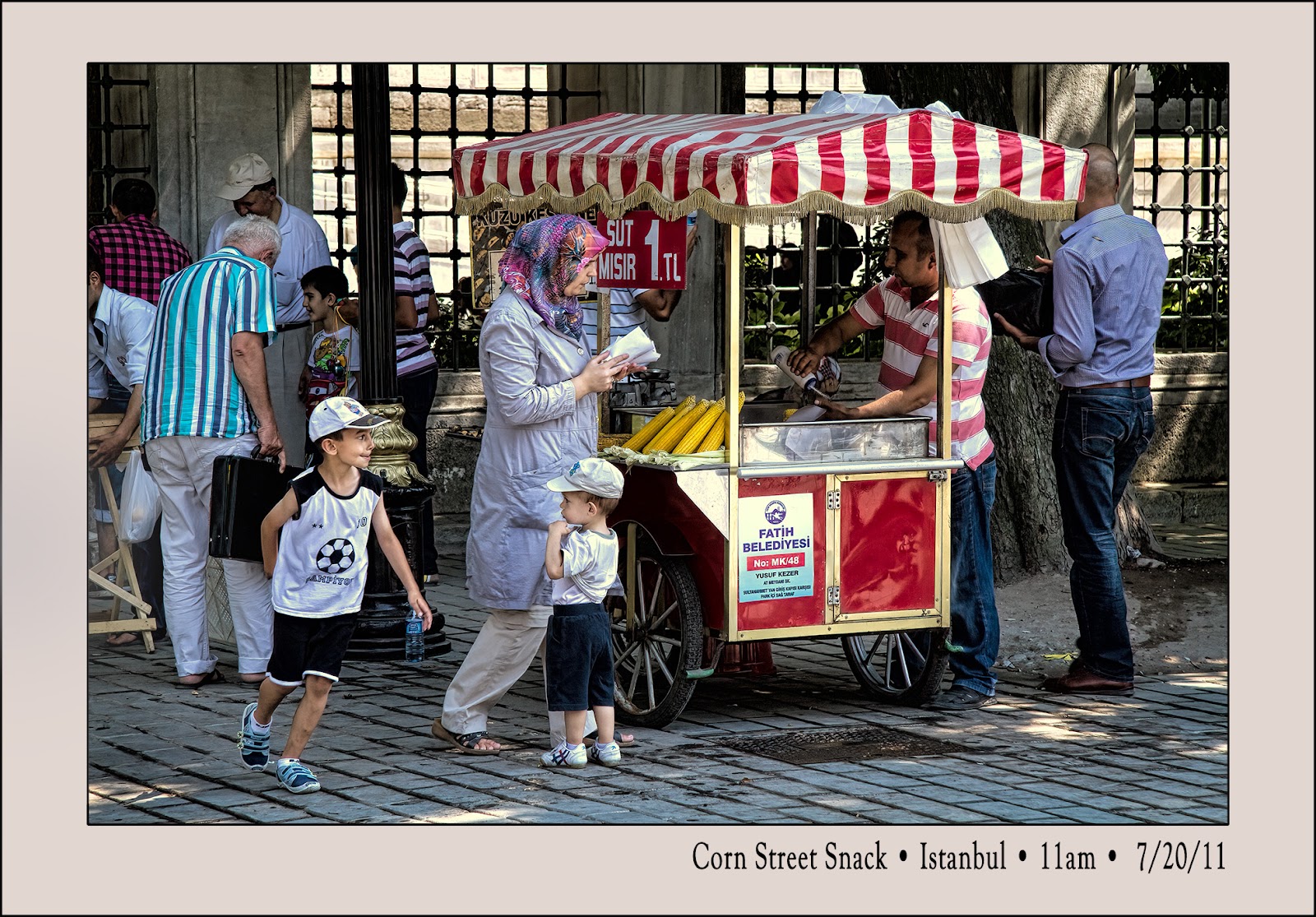
Here's  a busy Istanbul July mid-day... Could it be anywhere? Vienna? Boston? Kampala? Hong Kong? Maybe it's Ushuaia, Calarney, or Nome? Nope, the details in this one image rule all of them away. Perhaps  Havana? Well, this summer woman, sandaled, scarfed, and coated won't fit there. And the corn vendor's probably not a common fixture in any of those places. Yet... the details that we see are invisible to Turks. An Istanbul photographer'd ignore this moment... her brain'd dump it into a "commonplace" bin. 

Fresh eyes see extra-ordinary details: Stuff that's so Turkish that Turks don't.... perhaps can't ... see it. Their eyes are blind to the green bricks, a licensed cobbed-corn vendor, and the boys gyrating about their bundled-up caretaker (mother? nanny? guardian? herder?). Cultures are revealed by their unexceptional. moments.

Show this image to a guy from Central Pennsylvania and he'll wonder why that woman's scarfed then snuggly  buttoned into a winter coat while the many men are summer clothed. And the answer might take centuries to unravel.

To me Lancaster, my home in Pennsylvania, is like that - what it doesn't see my mind can't ponder. Just wondering... Are cultures the sum of what their fish can't see? 

Saturday, March 7

Invisible Stuff


This is invisible. Neuroscientists proved that our mind's a lazy piece of meat. It does what it must, the rest... fuggedabouddit.... The brain doesn't put itself out. For example, on your way to work, or to visit a relative, you only tend to see what's out of place. The ordinary, the usual, the banal... The brain says, "Ho-hum" and never sends that information to the processor. Which is why we see... really see... through fresh eyes when we travel down new roads. 

Oh, and even then we tend to filter away the commonplace. "ZAP!" I've transported you to say, Istanbul, and out of your hotel window there's a distant view of the Great Blue Mosque. "Magic," you mutter as it shimmers under a morning sun. And you never see the dumpsters or even the parking lot where they're sitting below. 

Nor will you see, really see, a turret atop a tiled roof in the next block that's accessorized with trash, sat-dishes, pipes, and wires snarling patternlessly. Actually the brain not only filters out the common, but also the pointlessly ugly. 

Ugly rarely gets gallery wall space, or storage room in those lazy pieces of meat between our ears. Why use up the energy to record then retain this sort of thing? And yet the common and the ugly fill the majority of every space between pockets of beauty.  It makes me wonder what else our efficiency-censors delete. What ideas we won't consider because the facts are... invisible. 

Saturday, February 14

Tough Art!

This sits in Istanbul's Hagia Sophia. Well actually it sits atop a marble jar brought, along with its twin, to Istanbul in the 15th century by Murad III. It probably sat outside for more than half a century before that in the ancient Roman city of Pergamon on the Western tip of Greece.

It's a jaw-dropper... A huge thing, some six or seven feet tall: an urn carved from a solid block of marble that was used in lustration ceremonies.

"Say what?"

Yeah, I had to look that up. Seems they filled these things with oil to create magic circles around infants during naming ceremonies. The belief was that evil was banned from the circle while goodness flowed in. A lot like baptismal ceremonies. You could get a big guy into this thing, with room to move around. Well, not that there was any need to cram a man into it, I'm just saying.

Now it sits in the Hagia Sophia where it's been indoors for another 500 years or so, protected from the weather... First in the Sultan's great mosque, and now that it's been converted into a museum, it's part of the collection of ancient Muslim and early Christian artifacts which the Turkish people maintain for all of us.

Recently Tom Dills asked some questions about the permanency of art, or at least our photographs. He mused about photographer and editor Bruce Jenson's essays on the topic. Bruce has often wondered about the eventual fate of this stuff we do... Well, the stuff that he does and by extension, what we do. Simply put, both Bruce and Tom wonder what happens to the photographs and art we've created when we die.

Which led me to wonder about the Lustration Urns of Pergamon. Did the designers/carvers of these things expect that a millennium or so after they stopped chiseling away stone that people would still wonder at their beauty? Or was the respect their work generated in its spiritual usage sufficient psychic reward. I guess that someone gave them some sort of direct economic payment for their efforts. And I also guess that, like artists always, the sheckles they got felt like too few.

Do you think it's the scale of these urns or their marble, that guaranteed them some sort of lifespan longer than their creator's? If they'd built them out of pixels, I wonder if they'd survive the winds of technology much less fashion, caprice, war, weather, and the tantrums of human taste. Understand, our photographic art is stored in the least permanent form ever imagined. Recently I tossed dozens of 78 RPM classical records of my father's that were created in the 1920s. I have no way of accessing their contents. I'll soon follow them to the trash with dozens of audio recording tapes which need reel-to-reel playback machines. And a lot of Super 8 and VHS family movies will follow them. Do you imagine that your carefully preserved images residing on virtual clouds somewhere will be any more accessible than the stuff you may now have on 8 Trac Tapes, cassettes,or even on CDs and DVDs?

Emily Dickinson had the advantage of "recording" her thoughts on paper, so that they were easily accessed so she could be "discovered" after her death. Imagine if she'd dropped them onto floppy discs?

Forget the "quality" of the work, what's "permanent" art demand? Not merely high levels of imagination and creativity, but some impermeable strata that can withstand time's vandals. Oh, and it probably should be big... like this lustration urn... Huge enough... to get noticed, right?

Monday, November 14

Basilica Cistern

<- Click here
Lost for centuries beneath the streets of Constantinople the Sunken Palace was rediscovered by the Ottoman Turks to water their magnificent Topkapi Palace. Built from parts from his collapsing Western Roman Empire by Justinian in the sixth century, the structure absorbed the work of over 7,000 slaves.
Fed by a twelve mile distant aqueduct and still a working engineering masterpiece, the spooky lighting flickers over crystal waters broken by the tails of cavorting fish. The space is huge and detailed with the work of the ancient buildings whose columns and arches were mined for this stunning yet mysteriously hushed Istanbul masterpiece.
Istanbul, about 500 feet Southwest and fifty two steps below Turkey’s breathtaking Hagia Sophia.
Canon 7D, PS4, Topaz, AlienSkin: Exposure: Agfachrome, custom textures and
brushes.

Monday, September 5

Bosporus Bustle

<- Click here
Gilt party boats
Crazy sway
In waves and wind.

A two arm gap
Over an
Ancient alley.

Istanbul, behind the Blue Mosque
Mixed Media, Canon 7D, PS4: custom brushes and textures, Topaz, Alien Skin: SnapArt: pastels.

Thursday, August 18

Hagia Sophia

<- Click here

Constantine built it
Fifth century.
Muslim repurposed it.
Now it’s a museum.
Making history is
Making a future…
We are part of
The future’s past.

The Hagia Sophia, Istanbul, Turkey
Canon 7D, PS4: custom brushes, filters, Topaz.

Very dim light… mysteriously pierced.

Sunday, August 14

Turkey Notes - Istanbul Morning

<- Click here
The morning call
Echoes from
Mosque to mosque.
A soprano melody
Along the city bustle
Melody line.

I took notes – with my Canon. Jotting onto FlashCards: my feelings. And of course in Istanbul, you feel the morning pull you awake. Is the city always sunny? dunno... but we never saw rainy clouds in July anywhere in the country. Of course it was mid summer and it was hot. Surprisingly there were palm trees in Istanbul. Since it sits at about the same latitude as Lancaster, we were told that the weather was comparable. But a palm tree would freeze its coconuts off here in the Red Rose city. Maybe it's because Istanbul pokes into both the Black Sea and the Med that it's warmer in winter? Anyone know?

Notice the buses in this scene. Istanbul has a spectacular public transit grid of mixed buses trolleys and light rail together with a bustling taxi and limo industry. The things are crowded at all hours. SRO... But with maybe 19 million people living in the city, a tad of crowding is expected, huh?

Last point... I tried to make this, at least in part, about the neighborhood mosque where the Imam chants/sings the morning call to prayer. And that is an interesting point. It was explained that while Turkey is a secular nation without a state church, the government does erect mosques and hires the imams who I suppose are sensitive to the um... sensitivities... of the interests of the place from which their checks come? Dunno, but it's an interesting arrangement.Actually the prayer call coming from the loud speakers on most minarets is a peaceful background sound, much like the peeling of church bells.

Istanbul, Turkey – Monday morning
Canon 7D, PS4: pano stitch, custom brushes, filters, Topaz, Alien Skin: SnapArt: Impasto, Custom textures.

Friday, July 29

Back From Turkey

<- Click here
Golden…
The morning.
Constantine might
Recognize his city
As his church turns
Golden.

Just back… from ten days straddling two continents..

The Hagia Sophia
Istanbul, Turkey
From the roof of the Ramada hotel
Canon 7D: PS4, Topaz, AlienSkin: SnapArt, Oil Paint, custom filters, textures, and brushes.

Okay... after writing all of that Andreas Manessinger broke it to me that this is NOT the Hagia Sophia but in fact it's the Yeni Camii or New Mosque. The Hagia Sophia - Constantine's fifth Century cathedral is yet to come.

Which brings me to...

<- Click here

Carved or released?
The houses of Mardin
Pop from their stone
Cool beneath
The broiling
Sun…

There is in Istanbul the world’s largest minature park – or park of minatures…
Miniaturk, Istanbul, Turkey
Canon 7D, PS4: Custom brushes, textures, Topaz2, AlienSkin: SnapArt, colored pencil, Bokeh 2, Planar.