Thursday, September 7

Ooops!


We boarded our Teeming River Cruises river boat on Friday, July 21. Ahead, a 12 day journey from Amsterdam, up and down rivers to Budapest. The Royal Crown carries just 90 passengers, and left Amsterdam at around 2:10 pm on Saturday with 89. Now why was that? 

Later I learned that Captain Hans de Gelder delayed leaving for a full 10 minutes beyond his scheduled 2pm departure. But the rules of the river, berthing, and crew assignments meant moving off even though a search for one missing passenger turned up nothing. Before disembarking they'd even called the Amsterdam police to see if the tardy guy was hurt, or perhaps hospitalized. Seems he left the boat around ten that morning to, "Wander around my favorite city.
Yeah, it was me. Without European cell service my iPhone, away from WiFi, was useless. Stupidly certain that the boat was leaving at 4, I contentedly snaped pix until about 1:55 when I decided to go back even though 4 was still way off. But the day grew hot, the mid-day lighting grew awful, and crowds were everywhere thick as July humidity. 

Imagine my surprise approaching the slip when, well, there wasn't a boat! 

At about 2:20 an empty Teeming Rivers slip adjoined Viking Cruise berths where greeters awaited their passengers. So I walked over and met a happy Irish fella in charge. Teeming River equips all of their disembarking passengers with identification cards that carry their boats' telephone numbers. The Viking guy got right on it. He sent me inside to relax, called the boat, and arranged a reasonable limousine service to meet the boat at a place called Roosseveltlaan, in Utrecht some  24 miles and 40 minutes away. My driver in a sparkling new Mercedes town-car described landmarks along the way. The Royal Crown's  captain detoured through a residential neighborhood's canal about twenty miles beyond Amsterdam. There the driver and I, along with a gaggle of curious neighbors, stood waiting (as a light drizzle fell) on this X for the Royal Crowne to poke its nose under that lovely bridge up there in the distance. 
 And, after about 20 minutes, it did poke under. But, as you can see from the picture here on the left, this was not a dock with no provisions for gangways or ladders. Instead the boat almost stopped, a guy grabbed my camera, while two other BIG fellas snatched either of my arms and flipped me like a cod onto the boat's deck. FWOOOP! As 89 passengers and a bunch of crew laughed and cheered, I became a celebrity. From that moment on, the crew and a lot of the passengers helpfully reminded me of departure times at each stop. 

BUT: The toughest part of all of this wasn't mine. Nope, my poor wife Rita was so worried. As the minutes ticked toward departure, her anxiety blossomed. Our reunion was tender yet, what is the exact word? Judgemental? Yeah, you remember that financer-guy Bernie Madoff? Well I know how Bernie felt. Fortunately I'm married to saint. 

Okay, with that outta' the way... How was the cruise? Where'd we go? What'd we see? Hear? Smell? Eat? Feel?


Sunday, September 3

Yeah, But Is It Art?


At a street market in Amsterdam there is a vendor selling boxed sets of compact paint spray cans. They come in sets of complimentary colors (including shading hues). And the boxes are cleverly open with an over-the-body strap that allows the user to dangle the cans at waist level for rapid access. European cities are more densely tagged with grafs than most of their US counterparts. They also seem to be far less political and/or gang related.
Questions: (1) Is this display on the corner of Elandsgracht and Derde Looiersdwars Straats in Amsterdam’s Centrum… art? Before rushing an answer, look how the city’s allowed that advertising box along the wall, and planted weed-like street signs. Look how bikes are strewn all about. See the utility boxes screwed to the walls. Is any of that, art? How should this scene look? Who makes that decision?
(2) Uncovered walls in Pompeii are wrapped in millennia-ancient tags. While much of the Pompeian graffiti seems advertising related (“Buy Deficia’s Big Sausages”) lots just reflect a passion of people to declare that they were there.. Is their an instinctual artistic need to brand a historic instant with their presence?
GEEK STUFF: Grabbed with my new Canon 7D through its workhorse 17-85mm zoom. Mid-day sun tested the 7Ds ability to capture HDR groupings… I’m thinking it dramatically passes that test. Right?

Thursday, July 6

Granada 10/26/17


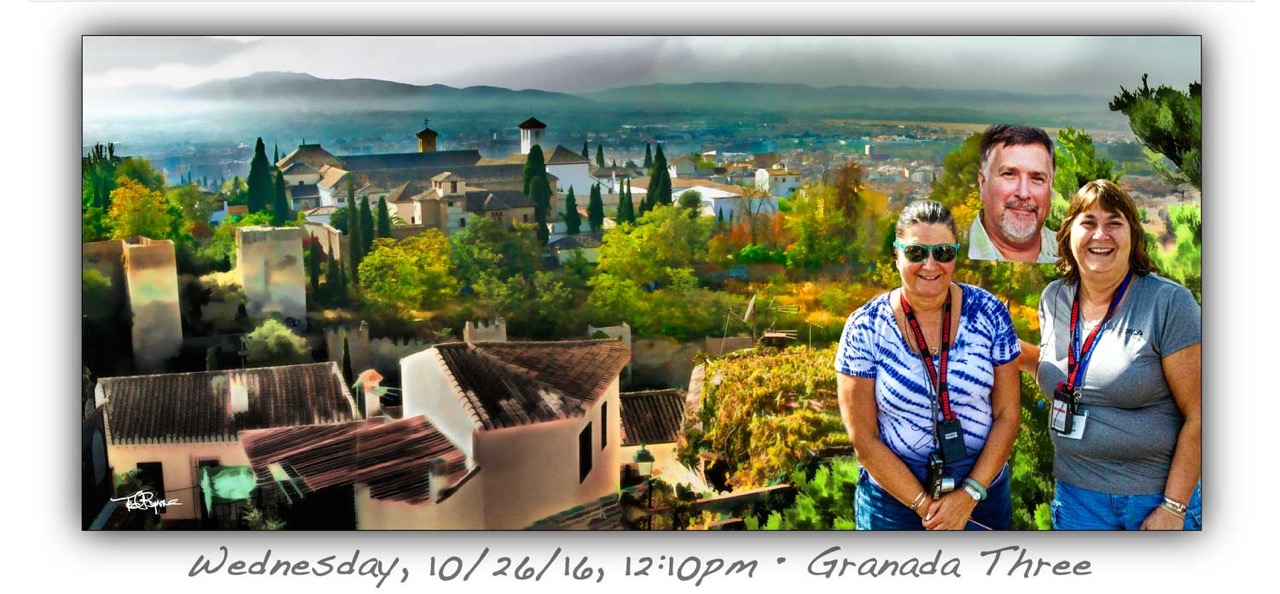
I  hope you’ve reviewed my 2016 feelings of; Madrid, Toledo, Cordoba, and Seville - right?Well after a 2 and 1/2  hour bus trip of some 156 miles we arrived in Granada on Wednesday October 25th.

An hour by car from the ports of the Mediterranean, Granada sits at the foot of the Sierra Nevada mountains which feed the four rivers that converge at the city which is home to a quarter million or so people and its entire market’s population’s about the same as Lancaster County, Pennsylvania - maybe a tad smaller. 


Sisters Deb & Joanne travelled Spain with the legacy, spirit, and love of their brother Bill.

Yeah, I captured this moment below in Granada. But without that title would you wonder if this man ran the New York Streets? Marseille's? Istanbul’s? Maybe Vienna, Dublin, Mbarara, or Lancaster, Pennsylvania? With the slightest switch in scenery – and I do mean ‘slight’ – here’s a big-city, 21st century morning moment. I wonder, did up-scale men scramble for exercise in 3rd century Rome? 2nd century Cathay? How about the Baghdad streets of say 1,500 BC?
Have men (and now women) always run for fitness when civilization’s security walls grew sufficiently thick? Or have they only recently begun to scamper in Moscow, Vienna, Tehran, or Bangalore? Is this a historically accurate urban cliché or just a momentary – yet widespread – fad?

Hmmmmmm? 
Our AM stop in the river city was...
Down below see? That’s Bruno of Cologne the founder of the Carthusian order of cloistered monks in 1084 in Calabria, Italy. In fact the Carthusians are also called the Order of St. Bruno. The man lived (1030-1101) within the eye of the theocratic/regal storms that roiled over Europe, and while he personally affected the role of a hermit, he was a learned confidant to both the Papal See (from the ecclesiastical Latin meaning holy seat: the name of of the Pope’s throne) and to worldly monarchial palaces.
This grotesquely beautiful statue adorns one of the most elaborate (some might say decadent) altars in the Catholic world, occupying the epicenter of Granada’s Carthusian cloistered monetary.
Bruno was apparently never tortured much less martyred so there’s little to explain the damage the sculptor imagined to his left eye nor the various carvings into his face. While he personally lived in austerity, he had access to assive resources which he used to endow churches and both the Carthusian and Cistercian orders of priests and lay brothers which he was instrumental in founding.
The statue (like much of the art in Granada’s Carthusian monestary) is grisly and consistent with the imaginations of directors of over-the-top horror movies. I have no idea how that connects with the quiet piety and deep scholarship of St. Bruno. But then, that’s the purpose of travel, right? To experience the puzzle of other cultures..
An example? Well here’s Eric discovering the grisly imagination of acclaimed 14th century artist Juan Sánchez Cortán.
TravelTime hostesses Lori and Courtney took turns as my gentle keeper. Okay, the camera distracts me so I straggle. Notice how casually Courtney stands there like, “Who Me?ME? Watching you Ted? Nah… "

But the stark cold monastery corridors all led to its central chapel which seems, well, un-monkly. 
Remember, these guys took vows of poverty in a land of enormous wealth that was concentrated in very few hands. Large hunks of the population were impoverished… while the monks of St. Bruno’s built this...
And this… Look familiar? (Hint: see the second image up above)
When it looks like gold… In 15th century Spain… it was gold.
Although downtown Granada wears it’s modern wealth  with comfort… There are, since 2009, numbers of once-elegant now-empty stores along its richest street. 
Bernie Hershberger frames the entrance to La Alhámbrá which  lets you feel the Moorish dreams that an army of stone masons built into this mighty 13th century citadel/palace overseeing Granada. Still mysteriously placid, the property transferred peacefully to the Catholics leaving its masonry un-cracked along with ancient ghosts.
The Alhámbrá’s a Sultan’s 700 year old palace with the Spanish city of Granada wrapped around the base of its hill-perch. As you can tell from this typical palace doorway, the Disney people have visited here a lot, Right?
You wander the Alhámbrá halls and feel the Moorish Sultan’s presence. What’s below though isn’t a window or door – just an alcove in an almost forgotten corridor. It’s a cranny carved into this space when much of Europe was only just opening its eyes to the Enlightenment. Years before ‘enlightened’ (yeah, that’s sarcasm) Christians expelled the Jews from Spain in 1492. 
Yet today when Christian Europe struggles against sharing chunks of its culture with new, largely Muslim, annexers whose ancestors they also expelled – the dusty beauty of this insignificant niche seems relevant. If a human is the sum of his/her ideas, it’s important to remember that culture is all about gathering, defining, and defending those ideas. Cultural clash threatens what people are – and yet this dimly lit niche glimmers a serenity that resonates across cultural battle lines.

Stairway To Heaven?
See the pedestal next to the steps below? It’s probably where a Seraglio’s guardian stood, like in Eduard Charlemont’s legendary 1878 painting <http://www.philamuseum.org/collections/permanent/102792.html>. Okay, Charlemont took a tad of artistic license, what can I tell ya? Still, can you image the fantasies this doorway to forbidden Seraglio chambers triggered 700 years ago when it was, um, fully functional? I’m thinking that Freud probably loved the symbolism of the structure, huh? (Don’t know the word “Seraglio”? Look it up! ;-)

Moorish architects understood the tension between the need for interior light and the rigors of Mediterranean heat. Their ingenious solutions involved the delicate latices which formed lace-like patterns across portals open to the skies. Here, in the torpor of an October afternoon, that exquisite workmanship allowed the interior in this corner a shimmering glow. A glow that reinforced the mysteries that once-awaited above.


And upstairs… Um, here’re are honeymooners - Robin & Michael.
The Alhámbrá  sprawls like the Topkapi Palace I’ve pictured among my Turkish images. I could narrow my eyes and easily imagine myself in Istanbul. The Alhámbrá's breathtakingly detailed with architectural accomplishments unrivaled throughout Europe for a century at least. And yet for all of its grandness, there are quiet spaces with mysteriously gentle lighting like these small rooms that sing to their solace.
Sometime in the 700s, the Sultan of Granada walked the gardens in his Alhámbrá palace. This corridor wanders for about a quarter of a mile parallel to another pathway to the left. Throughout there are water features and these intricately executed mosaic walkways.
The Moors ruled much of Spain from the 700s until the end of the 1400s. At their height of power, Granada was a richly artistic home of scholarship and science. And the Alhámbrá  was the boast of its affluence. Can you imagine the demand for stone masons, sculptors, painters, wood workers, carpenters, plasterers, plumbers, glass makers, and mosaic artists?

Actually all of the beauty and exquisite detail was a sort of marketing campaign. See, Granada's Alhámbrá was built in the middle of the 14th century by the caliphs of the Nasrid dynasty. Seems the Moors who'd invaded Spain in 711 were, by the 1300s, worried about their image of waning power. How better to project their dissipating might than to create a dream of heaven on earth? The place was created from plaster, timber, and tiles. Look at the serene workmanship around this pool that's survived  some seven centuries - even Napoleon's attempt to blow the entire place apart.


Feel the Moorish dreams that an army of stone masons built into this mighty 13th century citadel/palace overseeing Granada. Still mysteriously placid, the property transferred peacefully to the Catholics leaving its masonry un-cracked along with ancient ghosts.


And afterward...  a 310 mile, 6 hour bus ride to Valencia which meant...


And what about Valencia? Next time...

Thursday, June 29

Stairway to Heaven?

See the pedestal? It's probably where the Seraglio's guardian stood, like in Eduard Charlemont's legendary 1878 image.  Okay, Charlemont took a tad of artistic license, what can I tell ya? Still, can you image the fantasies this this doorway to forbidden Seraglio chambers triggered 800 years ago when it was, um, fully functional? I'm thinking that Freud probably loved the symbolism of the image, huh? (Don't know the word "Seraglio"? Look it up.)

GEEK STUFF: Moorish architects understood the tension between the need for interior light and the rigors of Mediterranean heat. Their ingenious solutions involved the delicate latices which formed lace-like patterns across portals open to the skies. Here, in the heat of an October afternoon, that exquisite workmanship allowed the interior in this corner a shimmering glow. A glow that reinforced the mysteries that once-awaited above. So I took the image my Canon 7D's 17-85mm allowed me to frame, then processed it first using Alien Skin's Exposure X2's ingenious Ilford B&W infrared film emulation. I always loved the spooky glow I got from that product decades ago.  

Then, I hand-colored the image in PS/CC. Finally I selectively brushed in handfuls of pebbly grain to evoke the dreamlike quality of age - you know, the opposite of feather-dusting furniture? I wanted to coat it in a patina of olden fantasy. 


Sunday, June 25

Daybreak on the 4th


Selected as the "Coolest Town In America", Lititz, Pennsylvania is home to the firms which do sound and sets for the world's most important touring music acts. Think Rolling Stones, jLo, Elvis, 4 Seasons, U3, Elton John, most key country acts, as well as Lady Gaga, and even Tony Bennet (Elvis? Well, once-upon-a-time, yep Elvis booked his sound through Lancaster County's Clair Brothers). And its in this quiet farming village where they all come to work out their pre-tour moves and acoustics. It's got an arts, and a professional community. All atop some of the richest non-irrigated farmland in the world! 

I grabbed this image on a 4th of July bike ride. This field of flags was just off the towns main cross street in front of Linden Hall's chapel. Founded in 1746 by the Moravian Church - this school was among the first to offer a rigorous college preparatory program for girls. 

GEEK STUFF: I pack a trusty Canon G10 into my bike pack. The small, light, G-series cameras offer both an optical range-finder (essential for focusing and framing against back-lit subjects like this) and full manual exposure, focus, and f-stops along with RAW space. No wonder so many pros carry them. The image was processed in PS/CC first in Photomap-Pro, then with a range of monochrome tools including the infrared augmentations in Alien Skin's powerful Exposure C2. 


Sunday, June 18

Details... Details...

The angel's in the details!
These things up there were a sort of marketing campaign. See, Granada's Alhambra was built in the middle of the 14th century by the caliphs of the Nasrid dynasty. Seems the Moors who'd invaded Spain in 711 were worried about their image of waning power. How better to project their dissipating might than to create an idea of heaven on earth? The place was created from plaster, timber, and tiles. Look at the dazzling workmanship that's survived  some seven centuries - even Napoleon's attempt to blow it apart.

Geek Stuff:  I imagine that big-time professional photographers have created rich images of the Alhambra's interiors. What I can't imagine is how they lit them. While the pros probably used 8X10 monster cameras locked rock-solid atop massive tripods and dozens of slave lights. Well on Wednesday, 10/26/16 at around 3pm - I pointed up my Canon 7D's 17-85mm lens which was widened to 17mm after I'd cranked up the ISO to 2000. That produced  a reasonably solid 1/125sec. at f/7.1 to grab good DOF and reasonable steadiness.  RAW let me dig out a couple of f stops in either direction to approximate an HDR dynamic range. Oh, each of those images above were stitched together in Photoshop CC from a number of panels.


O en Español:

El ángel está en los detalles. Estas cosas eran una especie de campaña de marketing. La Alhambra de Granada fue construida a mediados del siglo XIV por los califas de la dinastía nazarí. Parece que los moros que habían invadido España en 711 estaban preocupados por su imagen de poder menguante. ¿Cómo mejor proyectar su poder disipante que crear una idea del cielo en la tierra? El lugar fue creado de yeso, madera y azulejos. Mira la deslumbrante mano de obra que ha sobrevivido a unos siete siglos - incluso el intento de Napoleón de soplarlo aparte.

Geek Stuff:  Me imagino que los grandes fotógrafos profesionales han creado imágenes ricas de los interiores de la Alhambra. Lo que no puedo imaginar es cómo los encendieron. Mientras que los pros probablemente utilizaron cámaras de monstruos de 8X10 bloqueadas roca-sólidas sobre trípodes masivos con docenas de luces de esclavo. Bueno, el miércoles, 10/26/16 alrededor de las 3 pm - Señalé mi Canon 7D 17-85mm lente que se amplió a 17 mm después de que yo había accionado la ISO a 2000. Eso produjo un razonablemente sólido 1 / 125sec. En f / 7.1 para agarrar buen DOF y regularidad razonable. RAW me deja cavar un par de f stops en cualquier dirección para aproximar un rango dinámico HDR. Oh, cada una de esas imágenes de arriba fueron cosidas en Photoshop CC a partir de una serie de paneles.

Saturday, May 20

Real Alcázar Dome: Depth Rays


At about the time when Christians were recalling how to erect and decorate ambitious church domes: Pedro I in just two years (1364-66 ) built his palace - the Real Alcázar (The Royal Place) in Seville. Here's the ceiling of the (later added) _Salon de Embajdores_. It's where  Sultans met officials and dined formally. And where it's said (much like a similar scene from a Godfather movie), a later Sultan lured a rival's entire family for a banquet... and slaughtered them all. Tasty?

Anyway... This dome is made from interlaced staves of intricately carved and gilded wood. On the right and left: see the capitals atop two of the massive columns which support the massive weight of the dome? Amazingly so much of the Alcázar and Seville's Moorish antiquities have survived the geologically active quakes that shake so much of Spain flat.

Geek Stuff: This is a 17mm, three photo-pano stitched together from images made with my Canon 7D through its EFS 17-85mm f4-5.6 glass, processed in PS/CC employing myriad tools from Topaz, 0N1, and Alien Skin's enticing new Exposure X2. Of course the photos were handheld and shot at 2,000 ISO (1/13th of a sec).. Notice the lack of grain? Well, in fact I did a bunch of tricks to make the shadows and highlights pop while obscuring noise. The 7D has a powerful sensor though and low light noise is just a minor irritant problem.

Y por mi amigos de Espana...

Alrededor de la época en que los cristianos recordaban cómo erigir y decorar ambiciosas cúpulas de iglesias: Pedro I en sólo dos años (1364-66) construyó su palacio - el Real Alcázar de Sevilla. Aquí está el techo del (más tarde agregado) _Salon de Embajdores_. Es donde los sultanes se reunieron con funcionarios y cenaron formalmente. Y donde se dice (al igual que una escena similar de la película de El Padrino), un sultán más tarde atrajo toda la familia de un rival para un banquete ... y los mató a todos. ¿Sabroso?

De todos modos ... Esta cúpula está hecha de bastones entrelazados de madera tallada y dorada intrincadamente. A la derecha ya la izquierda: ver los capiteles sobre dos de las columnas masivas que soportan el peso masivo de la cúpula? Sorprendentemente mucho del Alcázar y las antigüedades árabes de Sevilla han sobrevivido a los terremotos geológicamente activos que sacuden tanto España plana.

Geek Stuff: Esto es un 17mm, tres foto-pano cosidos juntos de imágenes hechas con mi Canon 7D a través de su EFS 17-85mm f4-5.6 vidrio, procesado en PS / CC que emplea una miríada de herramientas de Topaz, 0N1 y Alien Skin Atrayente nueva Exposición X2. Por supuesto, las fotos fueron de mano y disparó a 2.000 ISO (1/13 de un segundo) .. Nota la falta de grano? Bueno, de hecho hice un montón de trucos para hacer las sombras y resalta pop mientras oscurece el ruido. El 7D tiene un sensor de gran alcance sin embargo y el poco ruido ligero es apenas un problema irritante menor.

Thursday, May 11

Andalusia Between Cordoba & Seville


So sunrise burnt away valley mists that coated a rare non-electric rail track wriggling through orange groves toward Northeastern mountains.
There are 88 bus miles stretching from Cordoba and Seville along the Andalusian plain. Andalusia includes Gibralter (Spain doesn’t recognize Britain’s claim to that rock), This plain is as much Europe’s Eastern entrance as Turkey is in the West.
Consequently beyond the bus windows is a plain that’s been swept in historic times by the native Iberians, Phoenicians, Carthaginians, Greeks, Romans, Vandals, Visigoths, Byzantines, Jews, Romani, myriad Africans, and Muslim Moors, along with the Castilian and other Christian North Iberian nationalities who conquered and settled the area in the latter phases of the Reconquista.
This far south, road signs are frequently written in both Spanish and arabic.

Geek Stuff Canon 7D through its EFS 17-85mm (f4-5.6). Processed in PS/CC employing tools by Photomatix, Topaz and Alien Skin’s Exposure X2.

Thursday, May 4

Flamenco!

Flamenco @ La Palacio Andaluz

Seville: If you can make it there (in flamenco) you can make it anywhere, right? The Palacio is a dinner theater with perhaps the best dance ensemble. Review: Really liked it. Good food, great dance, and since flamenco is theater… Well, there’s the hat trick :-}
Oh:  And La Palacio encourage photography.

Geek Stuff Canon G-10. Processed in PS/CC employing myriad tools by: Photomatix, Topaz and Alien Skin’s new Exposure X2. Stage lighting’s a challenge, so I try to make lemonade – y’know?

Saturday, April 29

OK, It's Worrisome, huh?

And these scholars are protesting fascism! Sigh. What the hell's happening on campus? Look, I'm a registered Democrat, at least through the next primary. After that? Grumble. Sorry, don't mean to be political, but once upon a time colleges seemed to be the place where beer and debate made the word "sophomoric" fun. Do fires, beaten women professors, speakers run off, and "debaters" like this gal seem kind of self indulgent. 

Question... by calling her a "gal" have I put my peace and quiet at risk of frazzling? Can you still say "gal"?  Or am I now unspeakably evil? If gal's gone, wuddabout "guy"? You get the feeling that there are flash fads frenzying flash mobs packed with nasty neurotic nut jobs? OOPS... NNNs are probably poised to give anyone a spontaneous dose of psychopathic proctology - which, may be the field of study that's replaced Western Civ? Is this a snarky transcendent moment or what? 

This gal and her pack of NNNs, waft the stink of 1930s Germany or Cultural Revolution China. Maybe both? 

It's worrisome, huh? 

Disclaimer: The basic image here isn't mine. It popped up on some news site without attribution. The processing is mine. I'm sort of glad I wasn't standing in front of this new-age beauty even with a very long lens. If anyone knows the photographer's name, please let me know - I'd like to celebrate her/his gonads. 

Sunday, March 12

Spain Day 3 • Bits of Cordoba • 10/24/16

Of course you can click on any image to see it large...


I've been apologizing to myself for getting sick. OK, that's dumb, but both Rita and I were felled during this trip - she got bronchitis, and since I'm more manly, well I grew it into pneumonia... Cough, Wheez... So this was the worst job of photographing I've done in decades. Sorry... sorry... sorry. Grumble.

In the 10th century, Cordoba was among the world's greatest cities.

The old city's snuggled behind it's massive ancient curtain wall protecting the colossal Mezquita. This Great Mosque embodied the power of the Islam on the Iberian Peninsula. Starting in the late 700s it was constructed by the Moors for over 150 years with lavish additions in the 10th century by Hakam II. The city was the sultan's citadel with a towering minaret high above all. A minaret which was replaced six hundred years later with this Torre del Alminar bell tower when Catholics reclaimed the city. 


The enormous Mezquita, now the Cathedral of Cordoba, is itself wrapped in a thick wall. Can't help looking at it's secluded rear door without imagining how it allowed dignitaries furtive entrance and exit. 


Spain's fabulous wealth allowed first the Muslims then the Catholics cities to compete with increasingly grand mosques, churches and then cathedrals. For example, here in the heart of the Mezquita is the very busy Catholic cathedral's main altar. Overdone? Hmmmm... I'm thinking that if this were music, the best descriptive word could be, um... cacophony. Each succeeding Cardinal must have sought some undecorated niche to stuff still more into this reconsecrated basilica.


This place reminds me most of a freeway at rush hour... clogged with architect and artist traffic. Maybe it was my fever, but the silently elegant remaining fixtures of the caliphs spoke to me more than the frenetic snarl of the cathedral's decoration. 


Wednesday, March 8

Valencia • 10/27/16 • 5:31p • Street Artist


Came across other North African street merchants last time I was in Italy. See the look on the guy's face? Before I could take a second shot, he'd swiveled to face into that doorway. The move seemed casual, graceful as a dancer. But he was hidden.

The work was nicely executed but probably computer stuff that was gone over with brushes. See how similar many of the images are? A man and his wares have probably stood against that ancient wall for centuries. Tough way to make a living from the swirl of passers-by. 

Here's the art business where rubber meets road. 

Tuesday, February 21

Meaning? 10/26/16 • Carthusian Tryptic.

Our brains really don't come empty. Millions of evolutionary years have wired in some instincts - which are sort of neuro-rules. Apparently ancient ancestors who were best able to make sense of a given moment, were more likely to live long enough to pass along an instinctual track in their babies' minds.I'm guessing that it fueled our ability to spot the tiger in the bushes, or the villain unsheathing his knife.

Anyway, what happens when there's really no order in what appears to be a simple moment? Granada's Baroque Carthusian monastery's like that. Its pieces won't fit together without some sort of key. But where is it? How to explain this happy couple, the dead clown and relatively ancient holes poked into walls - and an eye-fooling altar setting that's actually a painting? In fact, while the doorway steps there on the right are 'real', that alcove to the right of the painted altar piece was also, I think, painted to wickedly deceive the mind. 

So is there order among the couple and the tryptic behind them? Can your mind assemble the pattern, the order, the moment's reason and therefore its meaning? Or is this really a surrealist's romp? One thing's certain... Blown up to 7' on the horizontal edge - Here's an image that will ask everyone its questions each and every time they enter the room it dominates. 

Friday, February 17

Seville's 12th Century Gothic Cathedral


After he died a pauper, the monarchy resurrected Columbus as a hero. Cities competed... and still do... over claims to be the explorer's resting place. While the Spanish claimed his body rested here in Seville's magnificent cathedral no one had the courage to test the remains until a few years ago. DNA examination concluded that there were some milligrams of Columbus's corpse in here. Just which of his parts isn't made clear. Where's the rest? Maybe in Central America - who knows? 


My image belongs on a museum wall, y'think?