Showing posts with label art. Show all posts

Friday, April 21

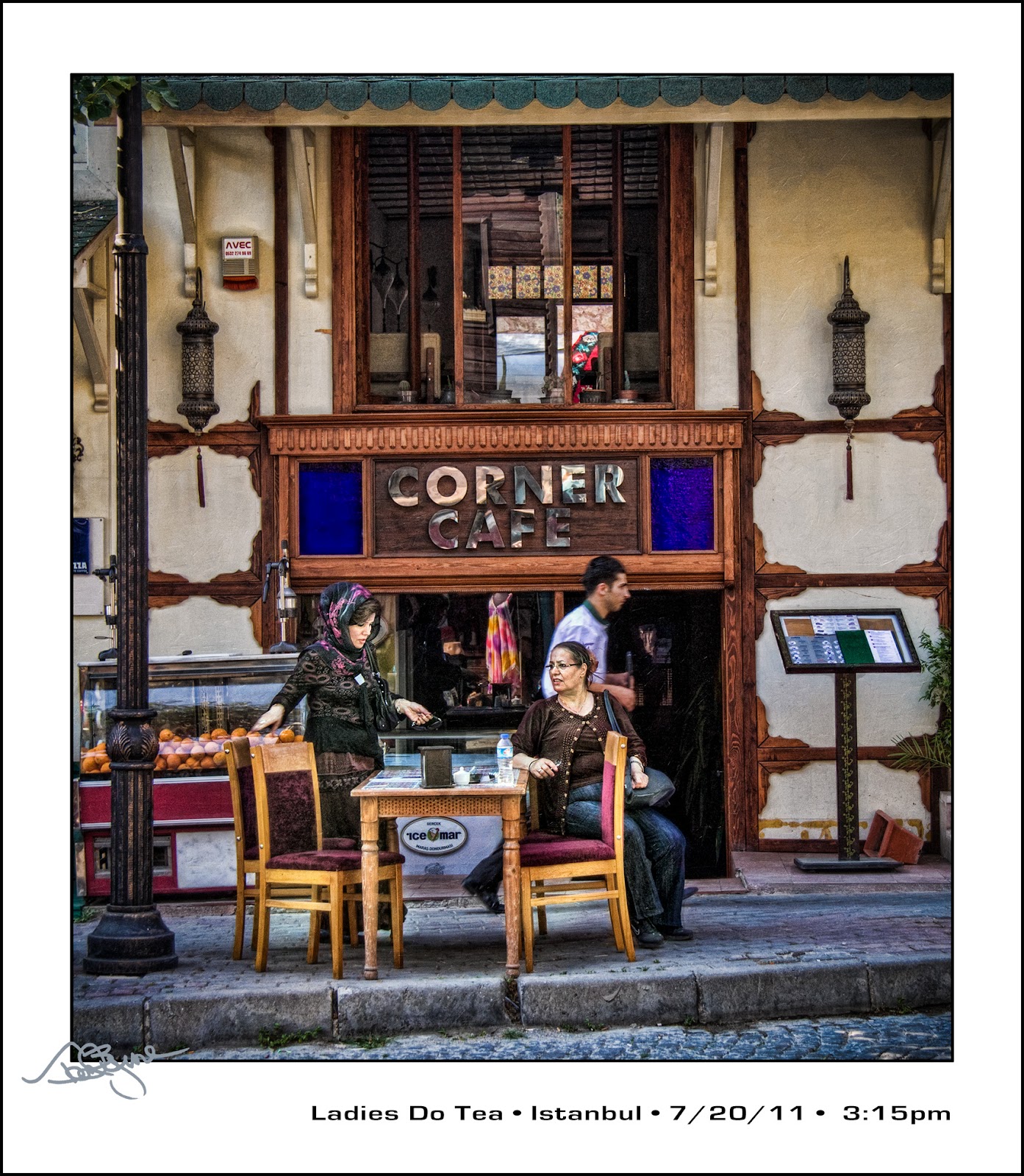
Ladies Do Tea: Knowledge Versus Wisdom


Relearning Photoshop craft is 33% boring, 43% frustrating, and 24% fascinating. Is this like Physical Therapy:  PT for the mind? Is this a sort of MT? 

Nudged by friends to send them samples of Turkey thoughts... the gap between knowledge and wisdom's growing larger. Our 2011 visit created a legacy of thousands of images...which is a reservoir of knowledge. A handful of them got extracted back then and can be accessed on the right if you tap on keyword "Turkey". Hundreds sat, never again visited, as newer stuff sang its own  luring song. 

This little Turkey MT project triggers an urge to poke mental plungers through my brain's constipated dendrite piping. Y'know, to kind of clean the shit outta my mind's pathways. As you can see from these last few posts, I'm visiting previously worked images to crank down my habit of over-processing: To remove the way it blocks the bridge between knowledge and wisdom. 

Anyone recall The Lovin' Spoonful's...

Hot town, summer in the city
Back of my neck getting dirty and gritty
Been down, isn't it a pity
Doesn't seem to be a shadow in the city
All around, people looking half-dead
Walking on the sidewalk, hotter than a match head...


What's "Ladies Do Tea" tell me about Turkey?

As the curtain opens... 

1. Setting: It was around 3pm, the hottest part of any day - and on July 20th in Istanbul ... hot means HOT!
 
2. The set was the storefront of an ancient two story building on an off-street about a block from perhaps the world's largest bazaar. 

3. The set's details are wonder filled. On the first floor a step-down into a small business called "Corner Cafe", its name splendidly displayed in an elaborate, hand tooled, wooden frame, in English. Look at the detailed lamps, the aquarium  piled with fresh oranges, the lamp stanchion, and the permanence of the detailed  table and chairs. 

4. And the second floor window passes through to its mate on the far wall. Is that a private apartment up there? And is the café's interior narrow as its second floor? Yet it looks so upscale. Which implies that with little room for tables, that the Corner Café needs to make its money on markup rather than volume.
 
5. Or something else... See the window beneath the sign? That appears to be a fine silken sundress hanging on display. Is this something other than a café, or something less? Surely this single outdoor table cannot be the sole source of this place's revenue? 

6. Then there are the two separate stories: one of Ladies Who Do Tea arranging themselves downstage and another of the busy waiter. 

7. And those ladies? See the new arrival there stage left in her elaborate scarf, ankle-long dress, and is she wearing a tag? Is she on break from a conference, convention, or forum? Is she visitor or resident of the city? Again, recall that it is the hottest hour of the day and look at her dark, long sleeves and head scarf. How warm? You know it's sunny: How? See in her left hand? She's about to drop her sun glasses. Is her costume a cultural uniform of some kind which armors her against streets hotter than a match head?

8. And then there's the other woman... in jeans! She's not head scarfed, yet wearing a sweater? So much going on in the silent film... How to explain the rules which must require these two distinguished ladies to flout the thermometer. And yet in a historically patriarchal society... to do it publicly without male companionship? 

9. How to tell they are distinguished? Their expressions, quality of their makeup, clothes, demeanor at a pricier café and their body language indicating both education and a familiarity with the place and their place in it.

10. And finally, there're the dramatic difference in the ladies' costumes. Hair scarves versus jeans? BTW, enlarge the image to look carefully at the new arrival's head, there's a large hair-bump covered in the back.

Is this a picture of a country well into cultural transition? Or are secularism and modernism in a tense struggle against tradition with victory unpredictable? That image's a rectangle of knowledge which makes it craft... the question: Does it ignite wisdom which makes it art? Hmmm.... 

A whole lotta MT's going on...


Tuesday, November 19

Grab - Puerto Madryn, Argentina Duo


1. Free carousel on the Puerto Madryn, Argentina beach.

So it's possible that art's about memories? That memories are the ultimate filter? 

But memories go goofy. Lots of people, like me, rarely dream in color. Something sucks away everything but shades of grey. Which is like emotional liposuction. Hmmmm.... Invented in 1983, the prefix to the word... "lipo" comes from the Greek word "lipos" for fat.

What's it mean to surgically remove all but various shades of one color? Is only fat gone? Or has the operation become... profound? While I've got color-blind cousins, I see what I call colors. And you do the same, right? So removing all but say, B&W shades strips away...? Is it possible, in any way, to do an accurate picture of anything without some commonly accepted agreement over the identity of say red from green? Green from blue? And all of what our brain defines of every gradation resulting from any possible mixture of RG and B?

Is all black and white representation... illustration... as opposed to say, photography?

Are your non-color dreams photography or illustration? Are your conscious memories, for that matter. photographic? Or are they something else each time you take them out for review? Tried another way... Is the mere act of "remembering" a... in photographic terms... a lossy process? Like jpeg images, they suffer a loss of information each time they are compressed and recompressed, and... 

2. Free carousel on the Puerto Madryn, Argentina beach.

Of course memories are filtered through a lossy screen each time they're examined... and they have a shelf-life problem even in their storage bins. Who can argue that their images are "representational" in any sense in the face of infinite contrary evidence? At best our memories are illustrative. And to the degree that we assemble them to draw conclusions - which after all is what art does - well,,,

Note that word, "draw". We're back to sucking. Huh? To draw is to what? To represent something with tools, words, or such. Or to pull something out. I can draw blood from your vein, draw gold from its vein, or draw a conclusion. But, a conclusion from whom?

Say what? Well do these two images draw any conclusions from you? About what? Or have I drawn conclusions that I'm representing in either one or the other of these images? Representing to whom? Me? You? 

Are we each sucking on the same story vein? Does color liposuction cause us to draw... different conclusions, me with my tools, you with from your own emotional vein? 

Are either of these images illustrations of reality? Or has the lossy process of art sucked away enough of the sculptor's stone that maybe a goofy angel gets released? Sigh... 

Enough questions for a crisp November night? 

Wednesday, September 18

Within the Hagia Sophia


Hand held in front of recovered early Christian artwork (6th century) under reclamation on the ancient cathedral’s walls. Um…. full disclosure… Every element in this image was in the Hagia Sophia on that afternoon. However the arrangement has been, um, enhanced :→

GEEK STUFF: Canon 7D, EOS EF-S17-85mm lens. Post in PSCC 2019 and assorted custom tools. ISP 1,500 – dim light, great Canon processor, note the lack of grain. The camera’s magical. BTW… The afternoon that I visited the Hagia Sophia was in MID SUMMER! Those burkas had to feel toasty, huh?

Tugging this concept together it occurred to me to wonder whether discovery can be substituted for creativity? Or for that matter, is process the same thing as artistry? I've asked many artist this same question, "What percentage of any final work did you discover during the process?" the average of the responses is about 85%! Hmmmm.... is art merely discovered rather than imagined? Perhaps illustration is the only true form of artistry since an illustrator's gotta' begin with an idea that s/he then imagines into finality? 
And yet, illustrators are not highly regarded by fine artists. Weeeeerd!

Monday, November 26

Synerdipity


So, how do notions of clean and clutter interact? I mean, minimalists believe that less is more,while that’s me up there in the title image, wondering if more is less?Huh?

Clutter’s the quarry of minimalists and me. We both want to shrink a story to its essence. Yet I do the opposite of whatever minimalists do. Is there a word for the opposite of minimalist?

The thesaurus cranks out synonyms for minimalism like; essential, austere, basic, conservative, moderate, spare, stark, or unadulterated. While its opposites are; embellished, ornate, lavish, and outlandish.

Giants of photography like Henri Cartier-Bresson hunted Decisive Moments: instants when life’s parts lined up into a meaning. They stalked frames of evidence. Like life: Cartier-Bresson’s stories are intricate yet straightforward. But even with their complexities it’s wrong to think of his images as embellished or outlandish. His parts epoxy together. 

Look here at Bresson’s Rue Mouffetard  Paris. 


Henri Cartier-Bresson: Rue Mouffetard, Paris – 1952
Last sold for $43,750

Here’s a sense of time, place, culture, and feeling. It’s a novel squashed onto one frame. Genius!

It’s the whole of a concept that makes a meaning. To paraphrase Antonio Salieri’s wonder over discovering Mozart’s hand-written scores in the movie Amadeus, “There are NO corrections, deletions or additions: None!  Add or remove a single note and the entire masterpiece implodes. It is as if he takes dictation from God!” 

So? Is Cartier-Bresson a minimalist?

I’m re-reading Michael Freeman’s Fifty Paths To Creative Photography, (IIlex Press 2016), and he’s triggered me to think that life and art are all about, lining things up – where to put stuff. Unlike other artists who could move things where they wanted, before digital it was photographers who had to move around. While it’s still a good idea, now we can move life's furniture in post. 

To photographic digital-artists, just as they are to many drawing-artists, what comes out of a camera are reference-images. Many of my artist friends take a series of photo-sketches… that they lug back to clip beside their easels. Some are facial or body expressions, some mood impressions, while many lack the lighting that ignites feelings. Most are simply snapshots of stuff – their photo sketchbook. But they contain the essence of theme for the artist to extract a narrative by realigning the pieces into an inclination greater than the sum of these parts. Which of course is the essence of conceptual art.

Serendipity happens when you find valuable or agreeable stuff you weren’t looking for. Synergy happens when the sum is greater than its parts.  Squoosh the two together and it makes me imagine what Synerdipity might mean. Isn’t synerdipity what the artist does? An artist wills things to relate. 

Once at a party I came upon a pair of literature professors wondering if one could think without words. Distractions happened and I never heard their conclusion – Damn! Perhaps they could have inserted “symbols” for “words” so that they wondered if thought had to involve the symbolic: and that thinking was a matter of sculpting an angel from a stone made up of symbols? Do y’gotta’ have a pile of tangibles to arrange into something intangible? 

For the moment let’s forget that our Latin/Greek based languages  (the only ones I know enough about to make sweeping statements) are all substantially metaphoric at heart. You know that abstract reasoning is also called conceptual reasoning. It’s an ability to problem-solve by identifying patterns, logic and trends from new data, then to focus conclusions. IQ is an attempt to measure degrees of insightful (or useful) intelligence while EQ is a similar attempt to measure the usefulness of an individual’s emotional tools. Great creators in every field are generally high IQ & EQ. They can CQ (Conceptual Quotient) at astonishing levels. 

And CQ is a tool of synerdipity. With or without words, artists reveal patterns. Now, let me digress for a moment. 

Regardless of the complexity of their challenge: mathematicians and engineers seek elegance. Which means they abhor clutter. So does an artist’s concept. In his frame of evidence for my conclusion look again at Bresson’s Rue Mouffetard. Think again about Solieri’s  startled reactions to Mozart’s scores. Both those scores and Carier-Bresson’s decisive moments are elegant in the mathematical and engineering sense. They can be condensed no farther. 

Their frames are bursting with meticulous meaning without any of the embellished, ornate, lavish, or outlandish which thesaurus-makers say are the antonyms for the word minimalism. They contain only the essential, austere, basic, conservative unadulterated pattern of whole concepts. And yet while we have a word for minimalists there is none for their opposite.

Here're three examples of photographic-based art which I could never have accomplished in a wet darkroom.

Here, look first at a 2007 shot I grabbed when a street carnival opened in a small Lancaster park.

Air Chairs • Buchanan Park, Lancaster, PA • May, 2007

The reference image showed a Ferris Wheel’s empty cages juxtaposed against flashing lights and a grey rain-stained sky. But the final image brought those lights and carriages together into a surreal feeling backlit by impossible heavens. 

Second in complexity here is a 2013 Dublin street capture – well actually two snaps. The first one was of street facades which, upon close inspection, showed lingering ravages of the real estate collapse of 2008. See how these are X-ray buildings? You can look right though them as most of their floors were empty. The second, which I placed in the foreground involved a mother and pram against a poster’ed wall. This second of the two suggested hope which was now both placed in front of, yet walled off from, both the immediate and distant past.  Again matching the dynamic (and depth of field) range of these two disparate photo-sketches into this seamless collage was a darkroom impossibility: Synerdipity.

In Sunshine or in Shadow • Dublin, Ireland • May, 2007

And finally, look here at “Time Ravages All Roses 

Time Ravages All Roses • Geo-Collage • May, 2007

Yeah, the reference pix were stark. The coffined background was captured in a Dublin mausoleum, while the taxidermy monkey stood years earlier on an antique shop’s dusty shelf in Beaufort, South Carolina.  I found the back wall beneath an Amsterdam bridge. 

Complexity grows among these three images. “Air Chairs” involves one reference image, “In Sunshine or in Shadow” two, and “Time Ravages All Roses” a bundle of stuff. But just as “Rue Mouffetard, Paris” demands all of its component pieces to complete its narrative, so too do the three images that follow. None of the reference images stood alone. It is their juxtaposition which adds sufficient detail to tell their stories. 

Mathematical elegance does not require fewer equations, but rather the fewest components to prove a premise.  I suggest that minimalism in conceptual fine art photography demands sufficient pieces to convey a unity of both complex thoughts and feelings. Which means adding stuff until (but not beyond) the narrative’s need for clarity. Which means that in conceptual fine art, more is necessary until the point is made elegantly. See what I mean? CQ is the tool of synerdipity.

With respect to conceptual art, more is frequently essential to make a Spartan point. Which brings me back to the question… If conceptual fine artists are not minimalists, then what are they called? Why is there no word that defines the opposite of minimalist: A word that compacts elegance, and irreducible meaning? Have you ever noticed that until there’s a word for something, it doesn’t exist? Take say, the internet”. Or how about feminism, cartoons, or fusion cuisine? Did electricity exist before it was named? How about econometrics, existentialism, or porn? 

Perhaps synerdipity’s the word for that which is definitely not Spartan, austere, spare or stark, yet not outlandish, decorous, ornate, lavish, or outlandish. Is the frame of evidence opposite to minimalist that carries none of those pejorative overtones synerdipidist?

 Just wrestling with the synerdipity of art, y’know?


Thursday, July 6

Granada 10/26/17


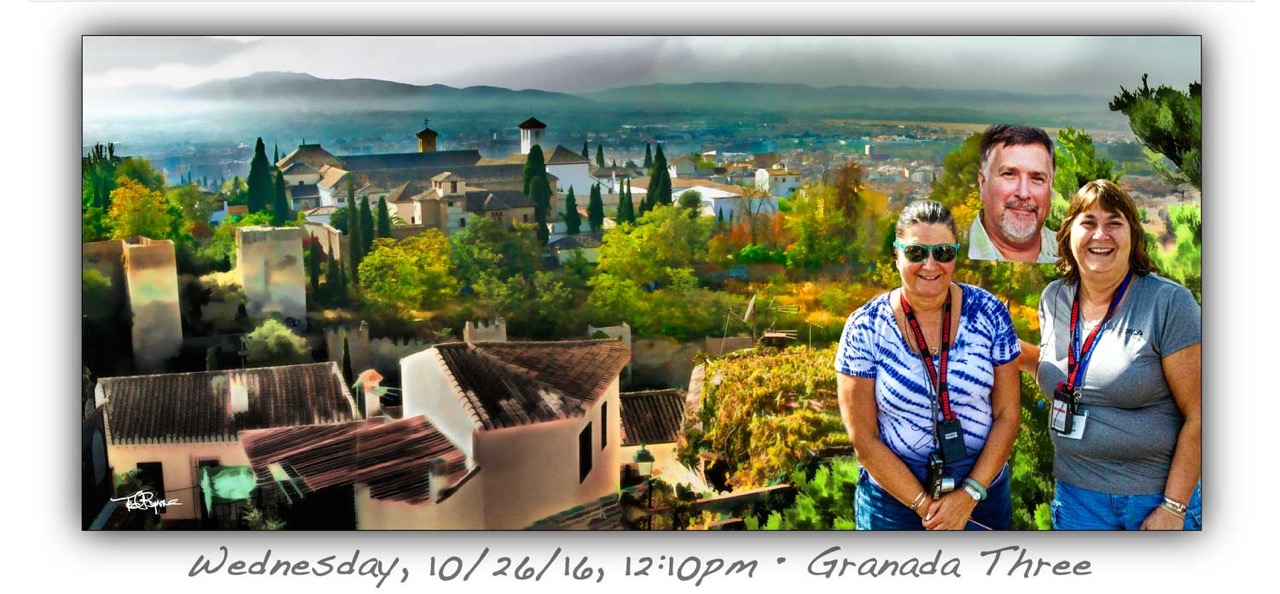
I  hope you’ve reviewed my 2016 feelings of; Madrid, Toledo, Cordoba, and Seville - right?Well after a 2 and 1/2  hour bus trip of some 156 miles we arrived in Granada on Wednesday October 25th.

An hour by car from the ports of the Mediterranean, Granada sits at the foot of the Sierra Nevada mountains which feed the four rivers that converge at the city which is home to a quarter million or so people and its entire market’s population’s about the same as Lancaster County, Pennsylvania - maybe a tad smaller. 


Sisters Deb & Joanne travelled Spain with the legacy, spirit, and love of their brother Bill.

Yeah, I captured this moment below in Granada. But without that title would you wonder if this man ran the New York Streets? Marseille's? Istanbul’s? Maybe Vienna, Dublin, Mbarara, or Lancaster, Pennsylvania? With the slightest switch in scenery – and I do mean ‘slight’ – here’s a big-city, 21st century morning moment. I wonder, did up-scale men scramble for exercise in 3rd century Rome? 2nd century Cathay? How about the Baghdad streets of say 1,500 BC?
Have men (and now women) always run for fitness when civilization’s security walls grew sufficiently thick? Or have they only recently begun to scamper in Moscow, Vienna, Tehran, or Bangalore? Is this a historically accurate urban cliché or just a momentary – yet widespread – fad?

Hmmmmmm? 
Our AM stop in the river city was...
Down below see? That’s Bruno of Cologne the founder of the Carthusian order of cloistered monks in 1084 in Calabria, Italy. In fact the Carthusians are also called the Order of St. Bruno. The man lived (1030-1101) within the eye of the theocratic/regal storms that roiled over Europe, and while he personally affected the role of a hermit, he was a learned confidant to both the Papal See (from the ecclesiastical Latin meaning holy seat: the name of of the Pope’s throne) and to worldly monarchial palaces.
This grotesquely beautiful statue adorns one of the most elaborate (some might say decadent) altars in the Catholic world, occupying the epicenter of Granada’s Carthusian cloistered monetary.
Bruno was apparently never tortured much less martyred so there’s little to explain the damage the sculptor imagined to his left eye nor the various carvings into his face. While he personally lived in austerity, he had access to assive resources which he used to endow churches and both the Carthusian and Cistercian orders of priests and lay brothers which he was instrumental in founding.
The statue (like much of the art in Granada’s Carthusian monestary) is grisly and consistent with the imaginations of directors of over-the-top horror movies. I have no idea how that connects with the quiet piety and deep scholarship of St. Bruno. But then, that’s the purpose of travel, right? To experience the puzzle of other cultures..
An example? Well here’s Eric discovering the grisly imagination of acclaimed 14th century artist Juan Sánchez Cortán.
TravelTime hostesses Lori and Courtney took turns as my gentle keeper. Okay, the camera distracts me so I straggle. Notice how casually Courtney stands there like, “Who Me?ME? Watching you Ted? Nah… "

But the stark cold monastery corridors all led to its central chapel which seems, well, un-monkly. 
Remember, these guys took vows of poverty in a land of enormous wealth that was concentrated in very few hands. Large hunks of the population were impoverished… while the monks of St. Bruno’s built this...
And this… Look familiar? (Hint: see the second image up above)
When it looks like gold… In 15th century Spain… it was gold.
Although downtown Granada wears it’s modern wealth  with comfort… There are, since 2009, numbers of once-elegant now-empty stores along its richest street. 
Bernie Hershberger frames the entrance to La Alhámbrá which  lets you feel the Moorish dreams that an army of stone masons built into this mighty 13th century citadel/palace overseeing Granada. Still mysteriously placid, the property transferred peacefully to the Catholics leaving its masonry un-cracked along with ancient ghosts.
The Alhámbrá’s a Sultan’s 700 year old palace with the Spanish city of Granada wrapped around the base of its hill-perch. As you can tell from this typical palace doorway, the Disney people have visited here a lot, Right?
You wander the Alhámbrá halls and feel the Moorish Sultan’s presence. What’s below though isn’t a window or door – just an alcove in an almost forgotten corridor. It’s a cranny carved into this space when much of Europe was only just opening its eyes to the Enlightenment. Years before ‘enlightened’ (yeah, that’s sarcasm) Christians expelled the Jews from Spain in 1492. 
Yet today when Christian Europe struggles against sharing chunks of its culture with new, largely Muslim, annexers whose ancestors they also expelled – the dusty beauty of this insignificant niche seems relevant. If a human is the sum of his/her ideas, it’s important to remember that culture is all about gathering, defining, and defending those ideas. Cultural clash threatens what people are – and yet this dimly lit niche glimmers a serenity that resonates across cultural battle lines.

Stairway To Heaven?
See the pedestal next to the steps below? It’s probably where a Seraglio’s guardian stood, like in Eduard Charlemont’s legendary 1878 painting <http://www.philamuseum.org/collections/permanent/102792.html>. Okay, Charlemont took a tad of artistic license, what can I tell ya? Still, can you image the fantasies this doorway to forbidden Seraglio chambers triggered 700 years ago when it was, um, fully functional? I’m thinking that Freud probably loved the symbolism of the structure, huh? (Don’t know the word “Seraglio”? Look it up! ;-)

Moorish architects understood the tension between the need for interior light and the rigors of Mediterranean heat. Their ingenious solutions involved the delicate latices which formed lace-like patterns across portals open to the skies. Here, in the torpor of an October afternoon, that exquisite workmanship allowed the interior in this corner a shimmering glow. A glow that reinforced the mysteries that once-awaited above.


And upstairs… Um, here’re are honeymooners - Robin & Michael.
The Alhámbrá  sprawls like the Topkapi Palace I’ve pictured among my Turkish images. I could narrow my eyes and easily imagine myself in Istanbul. The Alhámbrá's breathtakingly detailed with architectural accomplishments unrivaled throughout Europe for a century at least. And yet for all of its grandness, there are quiet spaces with mysteriously gentle lighting like these small rooms that sing to their solace.
Sometime in the 700s, the Sultan of Granada walked the gardens in his Alhámbrá palace. This corridor wanders for about a quarter of a mile parallel to another pathway to the left. Throughout there are water features and these intricately executed mosaic walkways.
The Moors ruled much of Spain from the 700s until the end of the 1400s. At their height of power, Granada was a richly artistic home of scholarship and science. And the Alhámbrá  was the boast of its affluence. Can you imagine the demand for stone masons, sculptors, painters, wood workers, carpenters, plasterers, plumbers, glass makers, and mosaic artists?

Actually all of the beauty and exquisite detail was a sort of marketing campaign. See, Granada's Alhámbrá was built in the middle of the 14th century by the caliphs of the Nasrid dynasty. Seems the Moors who'd invaded Spain in 711 were, by the 1300s, worried about their image of waning power. How better to project their dissipating might than to create a dream of heaven on earth? The place was created from plaster, timber, and tiles. Look at the serene workmanship around this pool that's survived  some seven centuries - even Napoleon's attempt to blow the entire place apart.


Feel the Moorish dreams that an army of stone masons built into this mighty 13th century citadel/palace overseeing Granada. Still mysteriously placid, the property transferred peacefully to the Catholics leaving its masonry un-cracked along with ancient ghosts.


And afterward...  a 310 mile, 6 hour bus ride to Valencia which meant...


And what about Valencia? Next time...

Friday, May 27

Tell Me A Story • 4: Madonna

Race Against Racism runner(a)  • 4/30/17 • Lancaster, PA
Mysterious eyes. 

When color's surgically cut away, is there more or less identity... More or less story... More or fewer clues? I wonder: Do blind people understand others at a deeper or more shallow level? Is radio in anyway superior to video in communicating the depth of personalities? 

There's a resistance to digital post-processing, dismissing it as inauthentic. The word manipulation is the common verb that describes digital post work. I prefer augmentation, even revelation since manipulation sounds what? Dreary? Calculating? Callow? Shallow? Never mind that painters, for example, do nothing but manipulate... augment... reveal... the realities they imagine. Ditto poets, novelists, and composers. Can you imagine someone charging a symphonic composer of manipulation? Playwrights routinely manipulate the emotions of audiences, don't they? Is that a bad thing?

Yet somehow describing digital post processing as manipulation is dismissive, even insulting. But that's not my real point here. Those most likely to critique the idea of augmentative post processing argue that purity lies only in the image which comes out of the camera, right? Now I've written about pre-processing (lens choice, lighting constructs, filters, makeup, wardrobe, scenery, POV... and like that), and even what I guess you could call immediate processing involving the manipulation of panning, framing, and DOF. All of that manipulates what comes out of the camera. And that doesn't even begin to touch the things camera engineers have built in to manipulate sharpness, color and dynamic range, Etc. 

But none the less, purists who reject digital post processing as in-authentic have no memory of the wet darkroom where printmakers first selected among radically different developer chemistries/timings/heat, then chose between diffuser versus condenser enlargers, contrast/texture/pigment of papers/substrate, developer dynamics, hold-backs, burnings-in, solarizations, and on and on to create a one-of-a-kind final print, even in monotone. The opportunities to create one-off darkroom prints in color increased exponentially. The fact is that there never was a final print that was not processed heavily by at least the photographic artists and perhaps different darkroom technicians, and retouchers (both on the negatives and prints). 

Is all of this sounding defensive? Okay.... look at this:

Race Against Racism runner (b)  • 4/30/17 • Lancaster, PA
As I roamed the park next to my home here in Lancaster on the morning of this year's Race Against Racism run - I consciously looked for a series of faces to speak to you dramatically in monochrome.I could have set my Canon 7D to bleach away all color and make captures only in monochrome. Why do that? Why not allow all of the information possible to reveal narrative arcs? 

So first I processed this image above as a square (you'll note that this and the next images will all be square-cropped, since my Hasselblad days, that format's been a powerful challenge to me). And I processed it for the most haunting dynamic range and sculpting, adding a touch of glow to offset the overcast lighting of that morning. Then finally worked in monochrome to release the image at the start of this essay. 

But the geek-stuff all involves focusing powerful tools to carve out a narrative arc that allows the lady to tell her story. So, what is it? Once again, Tell Me A Story - THE story which you read from faces. I'm convinced that every street portrait needs to trigger at least  a short story - and perhaps a poem, novel, or epic. Hell, maybe even a sonata, if you won't accuse the composer of manipulating the notes - or the mysterious eyes :-)


Friday, November 6

Masks Edit Reality

Image & Likeness?

Just outside of New York's Whitney Museum sat a table. You know, a street merchant parked a van and on this cold January day back in 2011 he'd unfolded an aluminum surface filled with African wood carvings. They weren't cheap.

Not In The Whitney
Perhaps it was the color, but this yellow guy grabbed my lens. You know how you collect images that whisper to you, but you can't quite hear their words? For years now, like a tune that worms through my brain but won't go away, I've wondered about this one. We live three houses down from The Lancaster Museum of Art and I wander through each new exhibit, frequently several times. This month the show is Masks Of Mexico. So, the other day in the shower it occurred to me that masks edit reality! Wow, an epiphany. But that's what those Mexican masks specifically did. The wearers assumed new identities and entered obscure feelings. They became a cast in stories, some ancient, others spontaneous.
Most Mexican and African mask-stories are deeply spiritual linked to legends of gods.  So I said to myself, "Self... If as the Western Holy Book claims that we are made in His image and likeness, then studying what we do must be a tipoff about what He does... Y'think?"

And since He rested on the seventh day... Well we sure know a lot about the night before Sunday, huh? And maybe why He really needed the rest. 


Friday, April 3

Radical Chromectomy

Because we can. 

You know, fine art photography's a lot like Everest. Why climb it? Because we can. 

Once upon a time an amateur fine-art photographer lacked the budget to do much creative color work. It was not just expensive, it was tedious. And with the fumes, the process was even a tad dangerous. It was always unpredictable and it ended in unreproducible results. Today full jacket chrome is ordinary as a mini-skirt in Spring. No, that's even too rare... It's ordinary as boy with lust in his heart when he spots a mini-skirt in Spring, right? 

So we're challenged with the emotional goo that chrome pours all over every image. The challenge is multiplied by a zillion. Hence the allure of B&W image making. Here, look at this 1949 Ford Anglia Bristol van that a Killarney shop's got in the middle of its floorspace. It glows with colored feeling. 


OK, and now, instead of finding ways to add chrome to our B&W darkroom-world, we can perform radical chromectomy. Like this...


Okay, have I added by subtracting? Or have I subtracted by adding the chromectomy? How much emotion is ripped away in B&W? Or... are these dramatically different messages, each as complex? But how can something be made differently complex by taking a scalpel to it? Hmmmm... 

Gotta' think on this :-) Should the age of mono-chrome be over? Or is mono really a surrender to the complex challenge of the colors of life? A retreat? 

Thoughts? 


Saturday, February 14

Tough Art!

This sits in Istanbul's Hagia Sophia. Well actually it sits atop a marble jar brought, along with its twin, to Istanbul in the 15th century by Murad III. It probably sat outside for more than half a century before that in the ancient Roman city of Pergamon on the Western tip of Greece.

It's a jaw-dropper... A huge thing, some six or seven feet tall: an urn carved from a solid block of marble that was used in lustration ceremonies.

"Say what?"

Yeah, I had to look that up. Seems they filled these things with oil to create magic circles around infants during naming ceremonies. The belief was that evil was banned from the circle while goodness flowed in. A lot like baptismal ceremonies. You could get a big guy into this thing, with room to move around. Well, not that there was any need to cram a man into it, I'm just saying.

Now it sits in the Hagia Sophia where it's been indoors for another 500 years or so, protected from the weather... First in the Sultan's great mosque, and now that it's been converted into a museum, it's part of the collection of ancient Muslim and early Christian artifacts which the Turkish people maintain for all of us.

Recently Tom Dills asked some questions about the permanency of art, or at least our photographs. He mused about photographer and editor Bruce Jenson's essays on the topic. Bruce has often wondered about the eventual fate of this stuff we do... Well, the stuff that he does and by extension, what we do. Simply put, both Bruce and Tom wonder what happens to the photographs and art we've created when we die.

Which led me to wonder about the Lustration Urns of Pergamon. Did the designers/carvers of these things expect that a millennium or so after they stopped chiseling away stone that people would still wonder at their beauty? Or was the respect their work generated in its spiritual usage sufficient psychic reward. I guess that someone gave them some sort of direct economic payment for their efforts. And I also guess that, like artists always, the sheckles they got felt like too few.

Do you think it's the scale of these urns or their marble, that guaranteed them some sort of lifespan longer than their creator's? If they'd built them out of pixels, I wonder if they'd survive the winds of technology much less fashion, caprice, war, weather, and the tantrums of human taste. Understand, our photographic art is stored in the least permanent form ever imagined. Recently I tossed dozens of 78 RPM classical records of my father's that were created in the 1920s. I have no way of accessing their contents. I'll soon follow them to the trash with dozens of audio recording tapes which need reel-to-reel playback machines. And a lot of Super 8 and VHS family movies will follow them. Do you imagine that your carefully preserved images residing on virtual clouds somewhere will be any more accessible than the stuff you may now have on 8 Trac Tapes, cassettes,or even on CDs and DVDs?

Emily Dickinson had the advantage of "recording" her thoughts on paper, so that they were easily accessed so she could be "discovered" after her death. Imagine if she'd dropped them onto floppy discs?

Forget the "quality" of the work, what's "permanent" art demand? Not merely high levels of imagination and creativity, but some impermeable strata that can withstand time's vandals. Oh, and it probably should be big... like this lustration urn... Huge enough... to get noticed, right?

Friday, March 28

Oh My Dears! So Motel-Room-Decor..

Show-opening. Gallery-party. A corner-coven of sniggering women.

One waggles her fingers at the walls and smirks, "This art? Oh My-Dears! It's all so, so… motel room, n'est pas?"

•••  •••  •••

Look… Here's how swanky art transforms a tacky motel room into a classy palace… um… right? See how the work's chosen to be precisely the correct size and hue? How it matches the designer bed spreads?


Sense how proudly important motel executives display their latest acquistion to a distinguished art authority… explaining how they've selected the work to balance the haute-style of the room's decor... it's spacious and high-fashion furnishings… while achieving the very latest in all-the-rage chic? 


Pictures bought by the palette, square foot, and square meaning. But… but… it sells. There are lots of motel room walls that create the biggest part of today's market for… for… Well, what?

Here's the challenge… To break into this lucrative high-demand space, how to give your images both mood-ectomies, and thought-ectomies? How to sink into a subliminal compliment to bedcovers and wall paint? 

You'd think that'd be easy, huh? But no. Too many artists still insist upon pursuing meaning, personality, idiosyncrasy, even… feeling.

The secret to the craft of motel room success is this… Make your work pretty and cheap. Hell, combine the two… make your work pretty cheap. You cannot be too pretty or too cheap. Follow that advice and you too will find important hotel executives bringing your work to the attention of people who'd otherwise not notice it. But remember, it will sell to those key purchasing agents who buy soap, towels, toothpaste and pillows precisely because no one will notice it!

Here, just copy unsigned work like this, and you can't miss…


Okay, guess you get the point. I hate it when my work ends up like this. Uh-huh, they are very high craft. But they look like wallpaper designs. Everything I tried failed to bring out the theme of isolation or alienation I'd hope this project would invoke. Each enhancement made them prettier and less a story or even a feeling. Leaving me with… "Oh My-Dears! It's all so, so… motel room, n'est pas?"

I should have just trashed 'em, but it's hard to toss a lot of hours of work. Sooooo… this is what blogs are for, huh? Whining? Dead-ends are… are… Sigh…. On the bright side, I can crank this stuff out like sausage and what it won't bring in mark-up, well supermarkets make it on volume, why not me?